
You are currently viewing How Many Calories Do You Burn in Home Workouts? 2026

How Many Calories Do You Burn in Home Workouts? 2026

1. Introduction

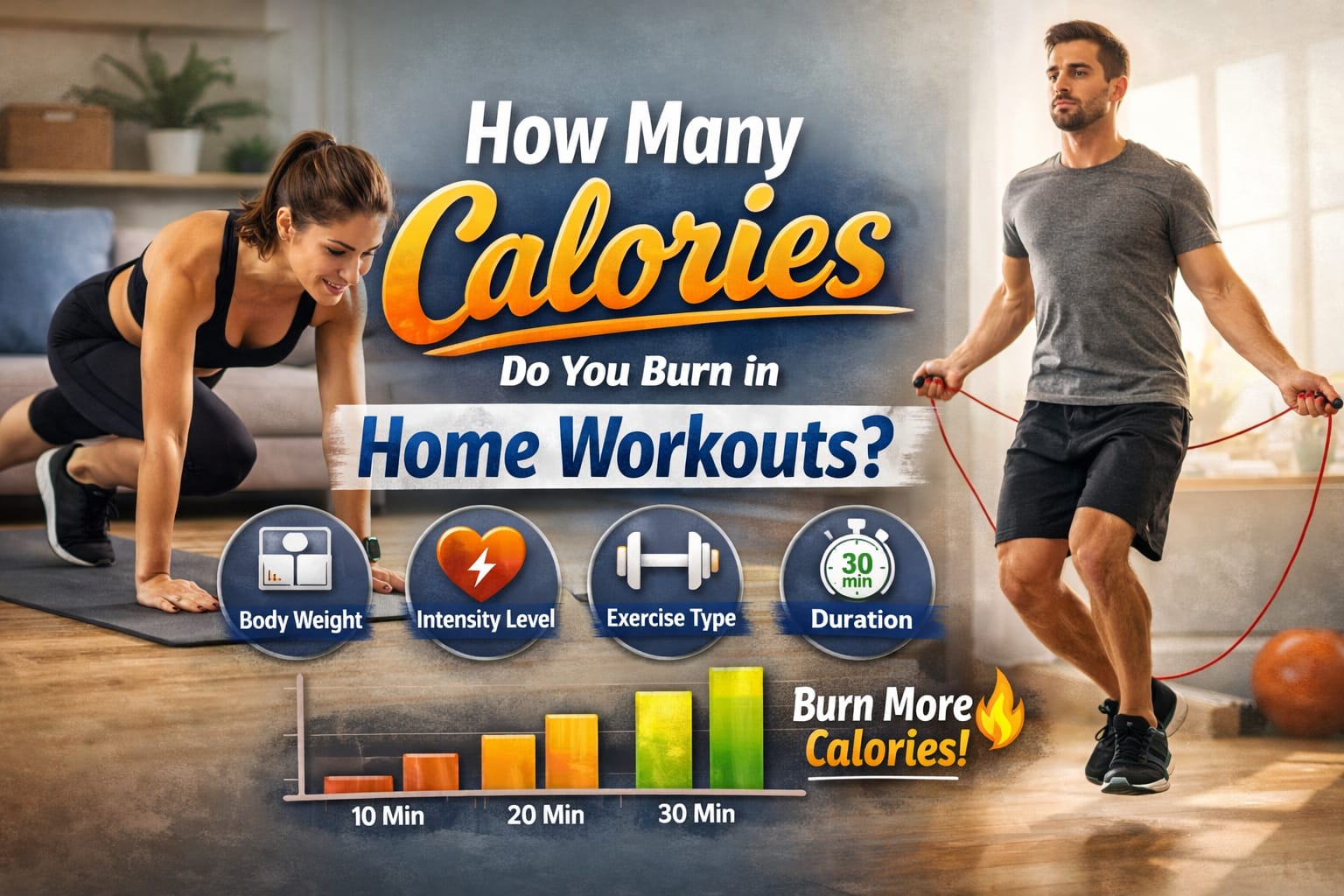
Home workouts have surged in popularity in recent years – especially during and after the COVID-19 pandemic – thanks to their convenience, accessibility, and overall cost-effectiveness for people looking to get fit at home. For example, searches for “home workouts” jumped by about 78% in early 2020 as people stayed indoors and sought alternative ways to stay active without going to a gym. Whether you’re following a HIIT routine on YouTube, using a beginner-friendly home exercise plan, or performing bodyweight workouts in your living room, how many calories you burn depends on several important factors that directly influence your energy expenditure. Key influencers include your own body weight, the intensity level at which you exercise, the types of movements you choose (such as cardio, HIIT, or strength exercises), and how fit or conditioned you already are. In this article, we’ll explore all these calorie-burning factors in detail, provide quick estimates of calories burned in 10, 20, and 30 minutes, offer a helpful 30-minute home workout calorie chart, and even walk through how to calculate your own personal burn rate using scientifically backed methods. Along the way, we’ll compare high-intensity vs. low-intensity home workouts, share practical 30-minute routine examples, include MET-based calorie calculations, and answer common questions so you can optimize your home workouts for maximum calorie burn and better results.

2. What Affects Calories Burned in Home Workouts?

2.1 Body Weight

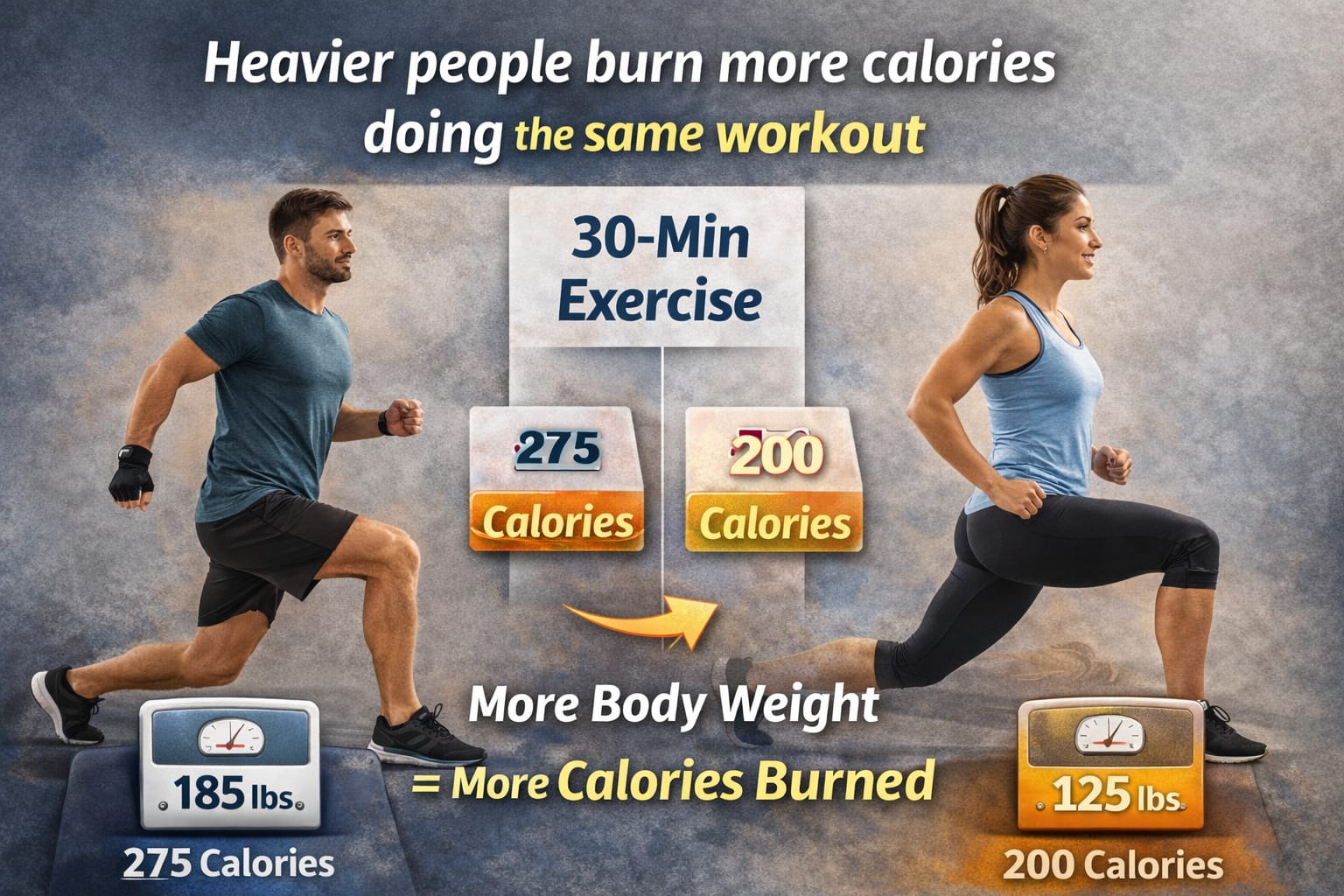
A man and woman doing lunges, showing how heavier individuals burn more calories during the same 30-minute workout.

Heavier people burn more calories doing the same workout than lighter individuals, simply because moving a larger body mass requires significantly more energy and increases total exertion. In practical terms, this means a 185-lb person performing 30 minutes of moderate calisthenics will naturally burn far more calories than a 125-lb person completing the exact same routine at the same intensity level. For example, Harvard Health notes that 30 minutes of moderate calisthenics burns about 189 kcal for a 185-lb individual compared to 135 kcal for a 125-lb individual, highlighting how body weight directly influences total energy expenditure. Thus, if you weigh more, you can generally expect a higher calorie burn for any given home workout activity – all else being equal, including effort, duration, and intensity.

2.2 Workout Intensity

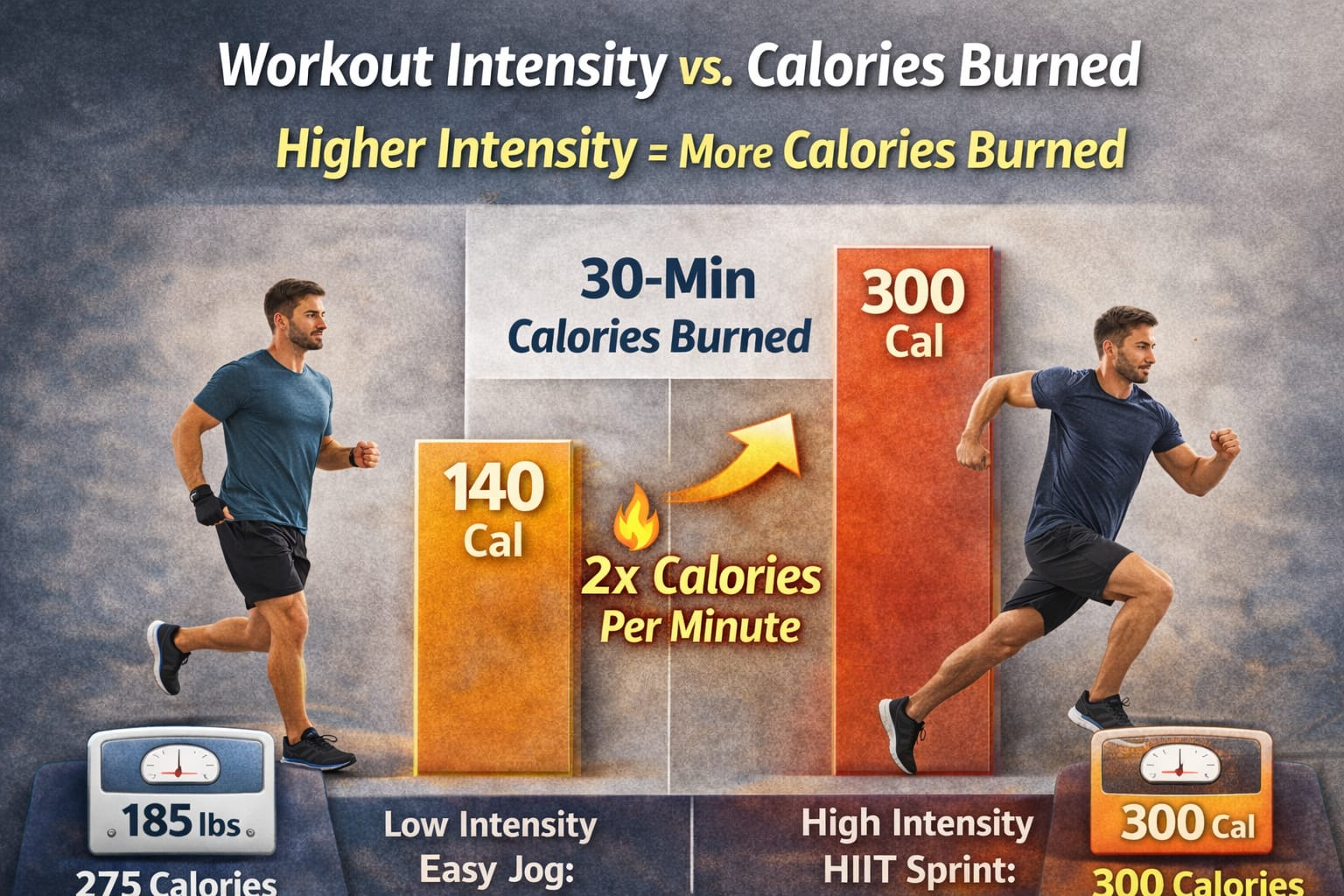
Comparison chart showing low-intensity jogging burning 140 calories vs high-intensity sprinting burning 300 calories in 30 minutes.

How hard you work out is a huge factor in determining total calorie burn, as exercise intensity has a direct and significant impact on how much energy your body uses. A gentle jog or light cycling session burns far fewer calories per minute compared to an all-out sprint, a fast-paced cardio session, or a high-intensity interval circuit performed at maximum effort. In fact, exercise intensity is directly proportional to calorie burn, meaning the harder you push, the more calories you expend within the same amount of time. For example, HIIT workouts, which include short, intense bursts of effort followed by brief recovery periods, can roughly double the calorie burn of a moderate-paced workout. As explained in the calculator.net guide, “the more intense the exercise, the greater the number of calories burned,” reinforcing the importance of effort level. In practical terms, this means 30 minutes of high-intensity intervals might burn 300+ calories, whereas 30 minutes of easy jogging might burn only 150–200 calories for the same person, even though the workout duration is identical.

2.3 Exercise Type

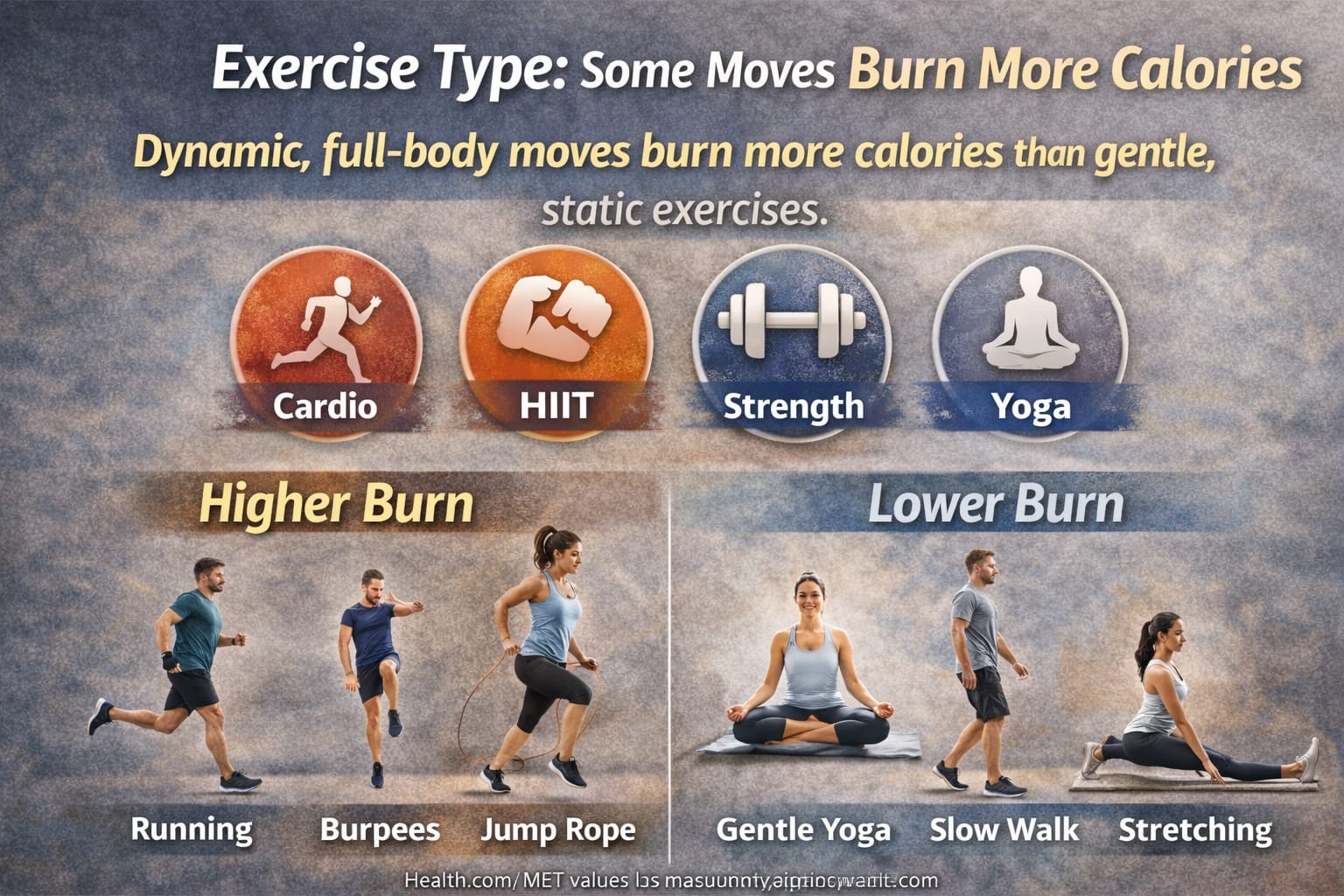
Collage comparing high-calorie-burning movements like running and burpees with lower-burning movements like yoga and stretching.

Not all exercises are created equal, and different movements can have dramatically different effects on how many calories you burn during a home workout. Full-body, compound exercises engage multiple major muscle groups at once and therefore require more energy, leading to a significantly higher calorie burn compared to isolated or static exercises that use fewer muscles. For example, Health.com reports that a 155-lb person burns about 185 calories in 30 minutes of hiking (a steady cardio activity) versus only 110 calories in 30 minutes of light weightlifting, illustrating how exercise type influences total energy expenditure. In general, dynamic movements like running, jumping rope, burpees, or circuit training (with squats, lunges, push-ups, and similar full-body exercises) burn more calories per minute than gentler activities such as light yoga, slow walking, or basic stretching. Even within typical home workout routines, vigorous moves like burpees or squat jumps will always burn more calories than a low-intensity plank hold or a set of simple crunches, since compound and explosive exercises elevate heart rate and activate more muscles.

2.4 Duration of Workout

The longer you exercise, the more total calories you burn, since calorie expenditure accumulates steadily over time when you maintain a consistent level of intensity during your workout. Calories burned increase in a roughly linear fashion as exercise duration increases (up to a practical limit), meaning that if intensity stays the same, your energy expenditure scales proportionally with the amount of time you spend exercising. In other words, a 60-minute workout typically burns about twice as many calories as a 30-minute workout, all else being equal, because the body continues using energy at a similar rate throughout the session. As calculator.net explains, doubling the workout duration roughly doubles the calorie burn, reinforcing the importance of total active time. This is why even a moderate exercise routine can add up to a significant number of calories when performed for a longer period—walking for an hour, for instance, will burn roughly twice the calories of a 30-minute walk, provided your pace and intensity remain consistent.

2.5 Fitness Level & Metabolism

Your fitness level and metabolic rate also play a significant role in determining how many calories you burn during a home workout, even when comparing two people of the same weight performing the exact same routine. Two individuals with identical body weight may burn different amounts of energy if one is far more conditioned or aerobically fit than the other, because a very fit person typically performs movements more efficiently and therefore burns fewer calories at the same effort level. Conversely, a beginner (or someone with lower fitness) often burns more because their body has to work harder to complete the same exercises. Calculator.net notes that “a person in better shape will burn fewer calories for the same exercise,” highlighting the impact of conditioning. Aging and body composition also matter: as people get older and naturally lose lean muscle mass, their resting metabolic rate slows down, while individuals with higher muscle mass burn more energy even at rest. In sum, people with faster metabolism, lower conditioning, or less experience may see a higher calorie burn than older, more efficient, or highly trained peers performing identical workouts.

3. How Many Calories Do You Burn in Home Workouts? (Quick Overview)

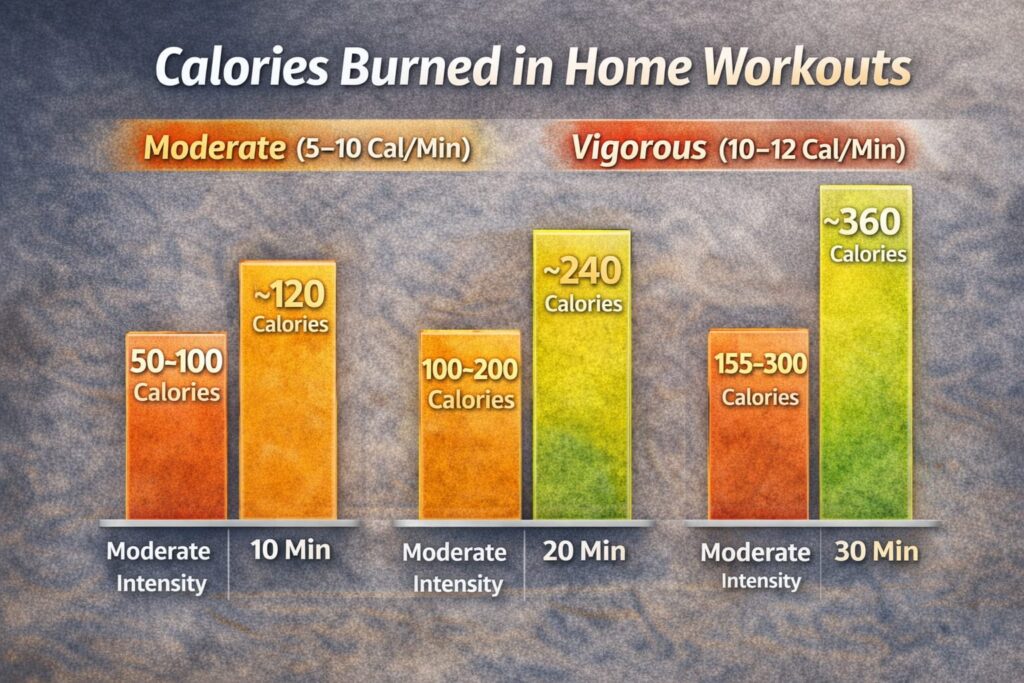
Bar graph showing calorie burn estimates for moderate and vigorous workouts at 10, 20, and 30 minutes.
  • 10 minutes: In a quick 10-minute burst, moderate-intensity moves might burn on the order of 50–100 calories (roughly 5–10 cal/min). A vigorous effort (like jumping rope, burpees, or fast-paced cardio intervals) could edge toward the high end (~100 cal in 10 min), while light activity (like gentle stretching or very easy stepping) might be as low as 30–50 calories, depending on effort and fitness level.
  • 20 minutes: Roughly double the 10-minute burn. So you might expect 100–200 calories for 20 minutes of moderate to intense exercise, or perhaps 60–100 calories if you take it very easy with slower-paced movements or low-impact routines.
  • 30 minutes: Common benchmarks suggest that a 150-lb person might burn around 250–350 calories during a 30-minute high-intensity home workout (e.g., HIIT, jump rope, or fast indoor cycling). By contrast, 30 minutes of moderate exercise (like brisk walking or a basic bodyweight strength circuit) might be closer to 150–200 calories, depending on intensity, pace, and rest periods.
  • High vs. Low Intensity: To illustrate intensity differences, consider these examples for a ~150-lb person. A 30-minute HIIT session can burn on the order of 353 calories, whereas 30 minutes of brisk walking (3.5 mph) burns roughly 120–133 calories. Jumping rope for 30 minutes can burn about 300 calories, while 30 minutes of gentle yoga might burn only ~90 calories, showing a wide spread based on workout type and effort.

These ballpark figures show that how hard and how long you exercise makes a big difference – something we’ll explore in more detail below, especially when comparing intensity levels, exercise selection, and overall duration in home-based workouts.

4. Calories Burned Chart for Home Workouts (30-Minute Workouts)

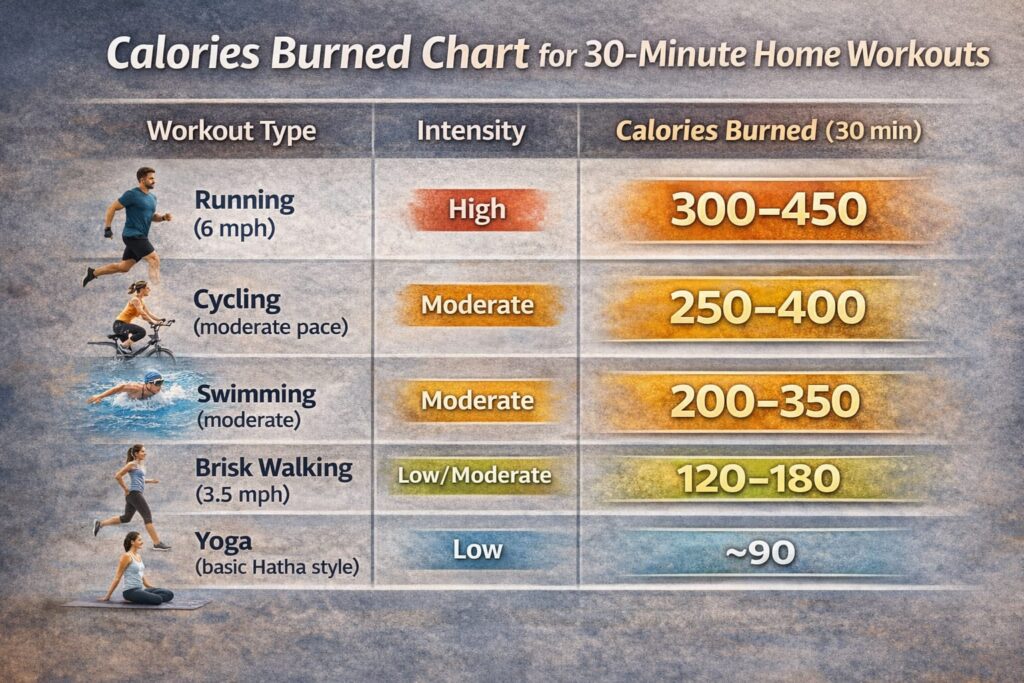
The table below summarizes typical calorie-burning ranges for various 30-minute home workout activities (for an average adult). These values depend on body weight and effort level, but give a useful guide:

Workout Type

Running (6 mph)

Cycling (moderate pace)

Swimming (moderate)

Brisk Walking (3.5 mph)

Yoga (basic Hatha style)

Intensity

High

Moderate

Moderate

Low/Moderate

Low

Calories Burned (30 min)

300–450

250–400

200–350

120–180

~90

Table comparing calories burned in 30 minutes for running, cycling, swimming, brisk walking, and yoga.

These chart values are based on published guidelines and examples. For instance, a 150-lb person burns about 300–450 cal running 6 mph for 30 min, but only around 120–180 cal walking briskly for the same time. Use this table as a reference to compare different home workout options.

5. Calories Burned per Minute (Exercise-by-Exercise Breakdown)

Home workouts involve many common moves, each with its own calorie burn rate per minute, and understanding these variations can help you choose exercises that maximize total energy expenditure. The burn rate depends heavily on the exercise’s MET value (a measure of intensity), the number of muscles activated, and how demanding the movement is on your cardiovascular system. Below we list popular home workout exercises and the approximate calories burned per minute by a ~155-lb (70-kg) person. (Exact values will vary by individual fitness level, technique, and effort, but these estimates clearly illustrate the relative intensity and calorie-burning potential of each exercise.)

Grid showing calorie burn per minute for burpees, mountain climbers, jumping jacks, push-ups, lunges, running in place, squats, and plank.
Each exercise burns calories at a different rate depending on movement intensity and muscle involvement.

5.1 Burpees
Burpees are a full-body, high-intensity movement that engages multiple major muscle groups at once. They are classified as vigorous calisthenics (around 7.5 MET). A 155-lb person performing burpees continuously will burn roughly 9–10 calories per minute, or about 270–300 calories in 30 minutes of nonstop burpees.

5.2 Jump Squats (Squat Jumps)
Jump squats involve an explosive squat followed by a jump, making them a powerful plyometric movement. This exercise falls under the 11.0 MET category for high-intensity HIIT-style moves. That corresponds to about 13 calories per minute for a 155-lb person (~390 calories in 30 minutes of constant jump squats).

5.3 Jumping Jacks
Jumping jacks are moderately intense cardio and typically classified as vigorous calisthenics (~7.5 MET). Expect on the order of 8–9 calories per minute (≈250–270 calories per 30 minutes), depending on pace and arm/leg range of motion.

5.4 Push-Ups
Push-ups are also categorized as vigorous calisthenics (MET ≈ 7.5) when performed continuously. A 155-lb person may burn about 8–9 calories per minute doing steady push-ups (roughly 240–270 calories in 30 minutes), especially when completed at a challenging tempo.

5.5 Running in Place
Running in place (or jogging in place) is roughly equivalent in intensity to moderate-paced running outdoors. For a 150-lb person, running at 5 mph burns ~287 calories in 30 minutes (~9.5 cal/min). Running in place produces similar demand, averaging around 9–10 calories per minute for someone weighing ~155 lbs.

5.6 Mountain Climbers
Mountain climbers (the plank-running movement) are extremely intense and rank alongside burpees in calorie burn potential. The metabolic compendium lists them at 11.0 MET, translating to about 13 calories per minute (≈390 calories per 30 minutes) for our example person performing them continuously.

5.7 Lunges (Bodyweight)
Bodyweight lunges, when alternated steadily, fall into the moderate calisthenics category at about 3.8 MET. A 155-lb individual burns roughly 4–5 calories per minute (around 130–150 calories in 30 minutes) when performing lunges at a consistent, controlled pace.

5.8 Plank
Holding a plank position engages the core muscles significantly but remains relatively low intensity compared to dynamic movements. It is classified at 2.8 MET (light effort). For someone weighing 155 lbs, this yields about 3–4 calories per minute (roughly 90–100 calories in 30 minutes of continuous plank hold).

5.9 Crunches (Abdominal Sit-Ups)
Crunches (or abdominal curl-ups) are also low-intensity exercises, rated at 2.8 MET. A 155-lb person can expect to burn about 3–4 calories per minute, totaling approximately 90–100 calories in 30 minutes when doing crunches continuously at a steady pace.
6. Real-World Examples of Calorie Burn (Routine-Based)

6.1 HIIT 30-Min Example

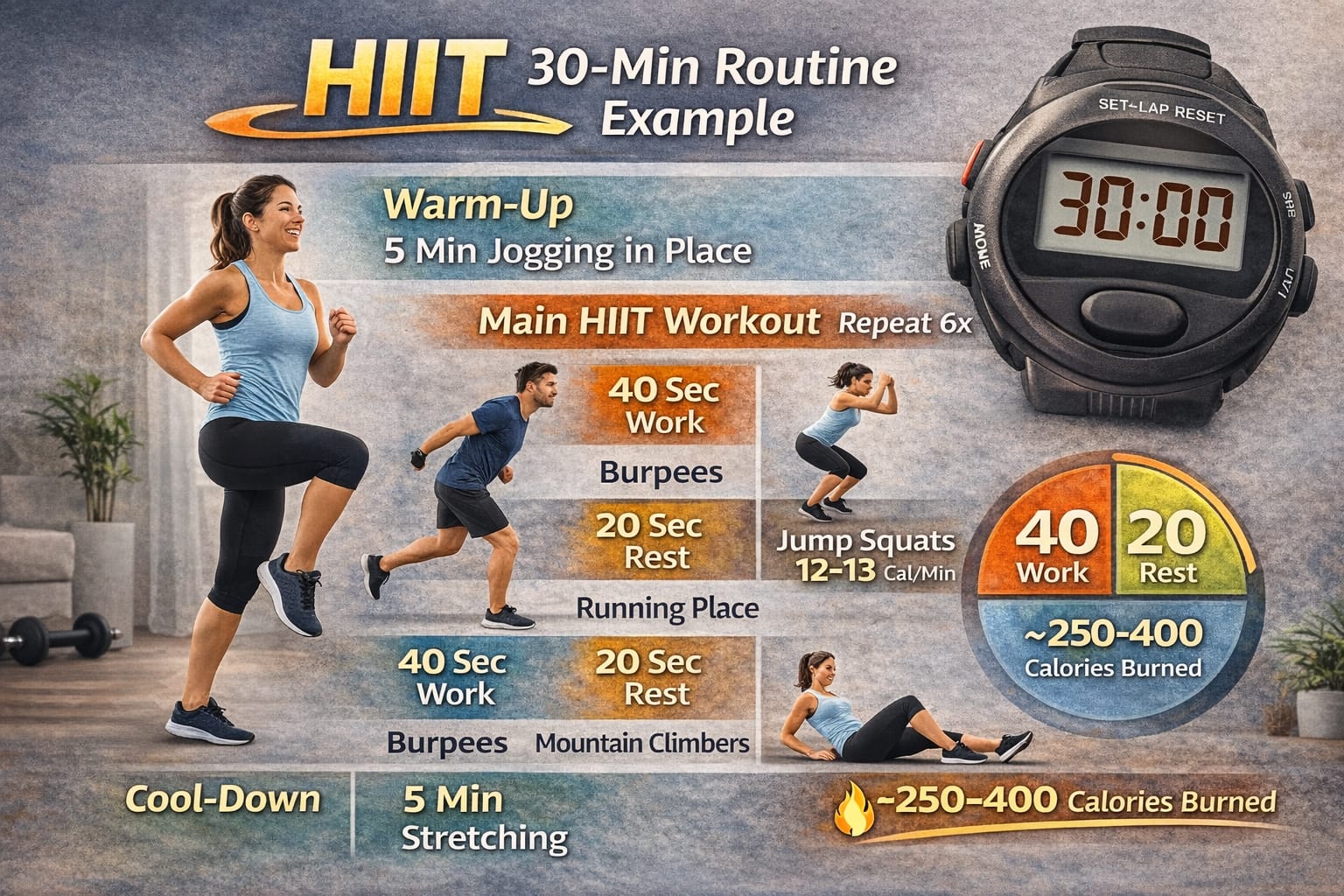
HIIT workout infographic showing warm-up, 40-sec work, 20-sec rest intervals, and estimated calories burned (250–400).

 A HIIT routine might involve 5 minutes of warm-up (jogging in place, dynamic stretches), followed by 20 minutes of 40-second all-out intervals (e.g., burpees, jump squats, mountain climbers, high knees) alternating with 20-second rest periods, and ending with a 5-minute cool-down. Such a structure is extremely intense, and research shows that a 30-minute HIIT session can burn on the order of 250–400 calories depending on effort level. In practical terms, a 155-lb person could burn around 300 calories during that HIIT session, plus additional afterburn calories (EPOC) afterward due to the elevated heart rate and metabolic demand created by high-intensity intervals.

6.2 Strength Training 30-Min Example

A 30-minute bodyweight strength circuit might include push-ups, lunges, squats, and planks, each performed for 45 seconds with 15-second rests between exercises, repeated in multiple circuits. This routine is moderate-to-high intensity and keeps your heart rate elevated while also building muscular strength. A session like this might burn roughly 150–250 calories for an average person. (For reference, many sources suggest ~130–260 calories per half-hour of strength training.) The exact calorie burn depends on tempo, rest duration, and exercise selection—shorter rests yield higher calorie burn. Note that strength training also raises metabolism after the workout, contributing to additional calorie burn later through the afterburn effect.

6.3 Low-Impact Cardio 30-Min Example

 A low-impact cardio session could include 30 minutes of fast walking, marching in place, or a dance/aerobics video performed at home. These exercises are easier on the joints but still elevate the heart rate and improve cardiovascular fitness. Brisk walking (3.5 mph) for 30 minutes burns about 120–180 calories for a 150-lb person. Similarly, a low-impact aerobic routine might burn around 150 calories depending on pace. While this is less than high-intensity workouts, it remains meaningful for calorie control, weight management, and daily movement goals.

6.4 Mixed Home Workout (Beginner-Friendly)

A mixed beginner-friendly 30-minute routine might combine light cardio and basic strength moves, such as a 5-minute warm-up followed by circuits of 45 seconds of jumping jacks, 45 seconds of bodyweight squats, 45 seconds of mountain climbers, and 45 seconds of walking lunges (with 15-second rests between moves), then finishing with a short cool-down. For a beginner, this type of routine might burn on the order of 100–180 calories depending on pace, technique, and overall intensity. The total burn is lower than a full HIIT session, but it still provides a solid baseline level of activity. As beginners improve their fitness levels, they can gradually increase intensity, reduce rest periods, and burn more calories with the same routine.

7. How to Calculate Your Personal Calorie Burn

7.1 MET Formula Explained Simply

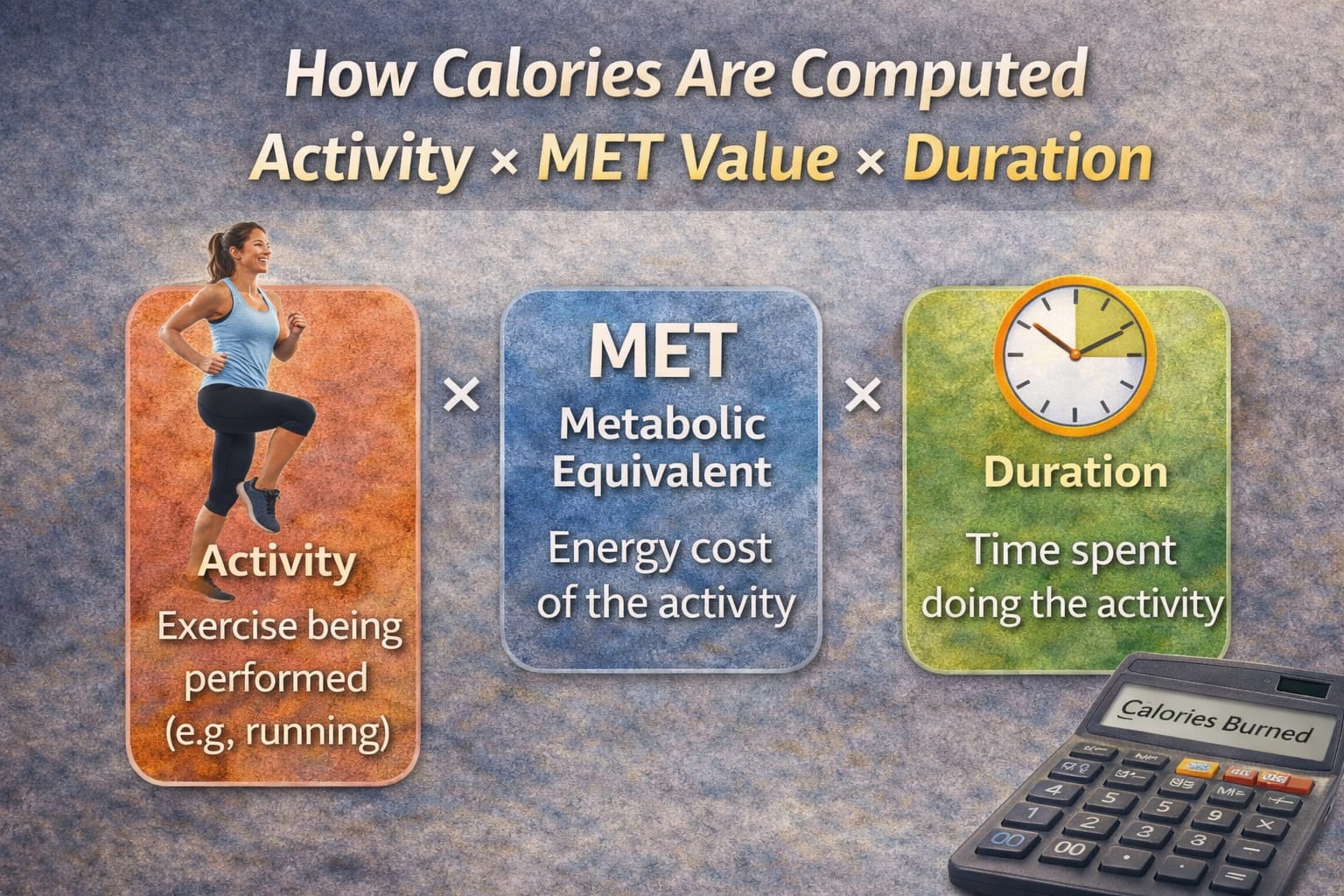
Infographic displaying MET formula: Activity × MET Value × Duration for calculating calorie burn.

Calories burned during exercise can be estimated using the MET (metabolic equivalent) formula, a widely used method in exercise science to measure energy expenditure. One MET represents the energy cost of sitting quietly (~1 kcal/kg/hr), and every physical activity has an assigned MET value based on its intensity level (e.g., walking ~3.8 MET, running ~8 MET, burpees ~7.5 MET). The formula for calculating calories burned is:

Calories burned = MET × body weight (kg) × exercise time (hours)

Or, in a more convenient form for quick calculations: Calories = MET × weight (kg) × time (minutes) / 60.

The calculator.net site provides this standardized formula. For example, if an exercise is rated at 8 MET (vigorous effort) and you weigh 70 kg, then doing it for 30 minutes burns approximately:

8 × 70 kg × 0.5 hr = 280 calories.

This simple equation helps estimate calorie burn across different activities and intensities.

7.2 Example Calculations for Different People

 Let’s use the MET formula for a 30-minute workout at 6 MET (moderate to vigorous effort) for people of different body weights:

  • 55 kg person: 6 × 55 × 0.5 = 165 calories burned in 30 minutes.
  • 70 kg person: 6 × 70 × 0.5 = 210 calories in 30 minutes.
  • 80 kg person: 6 × 80 × 0.5 = 240 calories in 30 minutes.

 Example calculation showing a 155-lb person burning 294 calories running at 6 mph for 30 minutes.This comparison clearly shows that heavier individuals burn more calories (165 vs. 240 calories) during the same 30-minute, 6-MET workout simply because more energy is required to move a larger body mass. You can plug in your own weight and the MET value of your specific exercise (from a MET chart) to estimate your personal calorie burn. (Keep in mind this is an estimate; actual burn varies with intensity, movement quality, rest breaks, and overall fitness level.)
 Let’s use the MET formula for a 30-minute workout at 6 MET (moderate to vigorous effort) for people of different body weights:

  • 55 kg person: 6 × 55 × 0.5 = 165 calories burned in 30 minutes.
  • 70 kg person: 6 × 70 × 0.5 = 210 calories in 30 minutes.
  • 80 kg person: 6 × 80 × 0.5 = 240 calories in 30 minutes.

This comparison clearly shows that heavier individuals burn more calories (165 vs. 240 calories) during the same 30-minute, 6-MET workout simply because more energy is required to move a larger body mass. You can plug in your own weight and the MET value of your specific exercise (from a MET chart) to estimate your personal calorie burn. (Keep in mind this is an estimate; actual burn varies with intensity, movement quality, rest breaks, and overall fitness level.)

8. How to Burn More Calories in Home Workouts

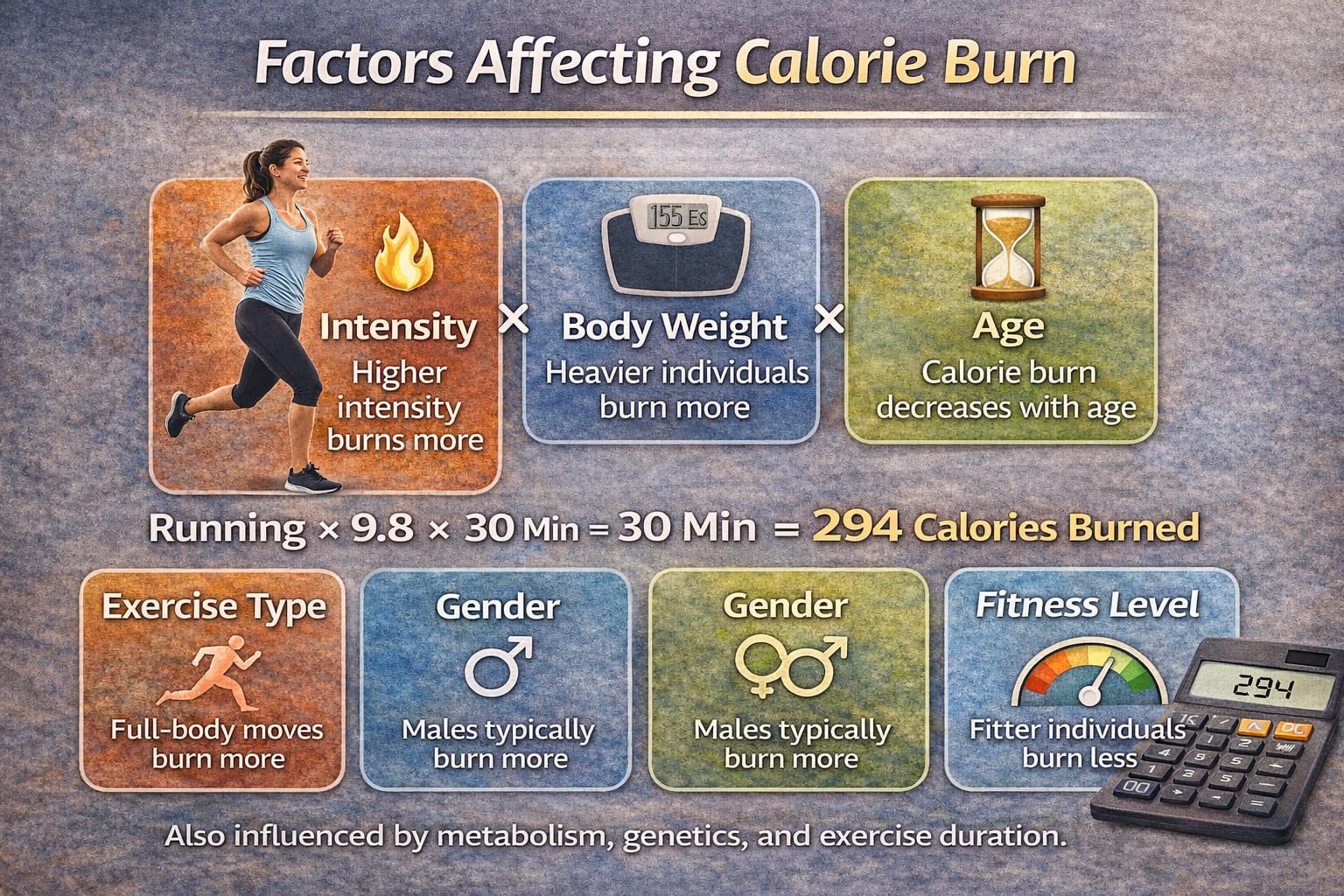
Infographic showing factors such as intensity, body weight, age, exercise type, gender, and fitness level that affect calorie burn.
  • Increase Workout Intensity Smartly: Push harder or add speed for a portion of your workout to significantly increase calorie burn. For instance, turn a set of 10 squats into 10 squat jumps, or increase your pace in a cardio move such as high knees or running in place. As noted, “the more intense the exercise, the greater the number of calories burned,” which reinforces how effort level directly influences energy expenditure. Even moderate exercises can become high-calorie burners when performed at maximum effort, allowing you to elevate your heart rate and increase total caloric output during the same workout duration.
  • Use Compound Exercises: Choose moves that use multiple muscle groups at once (e.g., burpees, jump lunges, push-up-to-jump combinations). Compound movements require more energy because they activate several major muscle groups simultaneously. Health experts point out that compound exercises like planks combined with jump lunges burn substantial calories “by engaging multiple muscle groups,” increasing both intensity and metabolic demand. In contrast, isolated moves (like a seated leg curl or small-target muscle exercises) burn less because they involve fewer muscles and generate lower cardiovascular workload.
  • Add Resistance (Weights/Bands): Increasing resistance makes your muscles work harder and increases both the immediate calorie burn and the metabolic afterburn (EPOC) that follows. This not only boosts energy expenditure during the workout but also elevates metabolism for hours afterward. One study noted that strength training can elevate metabolic rate for up to 48 hours post-workout, emphasizing its long-term calorie-burning benefits. In practice, adding dumbbells or resistance bands to bodyweight exercises (e.g., weighted squats, banded rows, or resistance-band deadlifts) increases calorie burn during and after your session.
  • Reduce Rest Periods: Minimize downtime between sets to keep your heart rate elevated and maintain a high-calorie burn. Keeping your body moving continuously—such as in a circuit, Tabata, or HIIT-style format—maximizes overall energy expenditure. Research recommends resting only ~30 seconds or less between sets for fat loss, since “short rest periods … maximize your calorie burn and energy expenditure.” Long breaks cause your heart rate to drop sharply, which reduces workout intensity and lowers total calorie burn significantly.
  • Follow Progressive Overload: Gradually increase the challenge over time (more reps, heavier load, tougher variations, or longer work intervals). As your fitness improves, you must increase the difficulty to continue burning calories efficiently and avoid plateaus. Because well-trained muscles adapt quickly, keeping workouts static will gradually burn fewer calories. Progressively adding challenge (e.g., more rounds, increased weights, or more intense exercise variations each week) ensures you continue burning a high level of calories while also building lean muscle, which in turn elevates your resting metabolic rate.
  • Track Heart Rate for Better Accuracy: Monitoring your heart rate during workouts can help ensure you stay in an effective calorie-burning zone and maintain proper intensity. Aim for 70–85% of your max heart rate during intense intervals. (For example, hitting 80–90% of max HR during HIIT is often advised for maximum fat-burning effect.) Using a heart-rate monitor or fitness watch removes guesswork—you’ll know whether you’re truly pushing hard enough or if your intensity has dropped below an effective level.
    Calorie burn tips for home workouts
    Boost your calorie burn by training smarter — not just harder.

9. Best Types of Home Workouts for Maximum Calorie Burn

Collage showing HIIT, Circuit Training, Dance Fitness, and Cardio workouts.

9.1 HIIT

High-Intensity Interval Training is king for burning calories quickly, especially in short home workout sessions. Short bursts of all-out exercise dramatically raise your heart rate and keep it elevated even during the brief recovery periods, allowing you to burn more calories in less time compared to steady-state training. Studies show that a 30-minute HIIT session can burn on the order of 250–400 calories (and often even more when you factor in the powerful afterburn effect). If your goal is maximizing calorie burn, including HIIT-style circuits—such as Tabata, EMOM, or high-intensity bodyweight intervals—is one of the most effective strategies for home workouts.

9.2 Bodyweight Circuit Training

Circuit workouts that combine bodyweight strength training and cardio exercises keep you moving continuously with little rest, producing a high calorie burn. Think squats, lunges, push-ups, and burpees performed in a looping circuit. These circuits elevate both muscular output and heart rate, amplifying total energy expenditure. Experts note that high-intensity compound moves (e.g., planks paired with jump lunges) “burn many calories by engaging multiple muscle groups,” making them highly efficient for at-home fat loss. A non-stop bodyweight circuit is essentially a DIY HIIT workout, torching calories while also building functional strength.

9.3 Cardio Home Workouts

Classic cardio movements performed at home—such as jumping rope, running or jogging in place, stair climbing, or fast-paced step aerobics—also burn a significant number of calories. For example, 30 minutes of jump rope can burn approximately 300 calories. Even without equipment, simple activities like fast-paced dance workouts, high-knee marches, or cardio boxing routines can get the heart pumping. Cardio sessions raise your heart rate for sustained periods, making them excellent for fat loss, endurance, and overall cardiovascular conditioning.

9.4 Dance Workouts / Aerobics

Fun, high-energy dance workouts (such as Zumba, freestyle dance, or classic aerobics routines) can burn hundreds of calories while remaining low-impact and beginner-friendly. Moderate-intensity dance workouts can burn 150–250 calories in 30 minutes, depending on pace and style. These routines are often easier on the joints compared to jumping or running but still elevate the heart rate and engage large muscle groups—especially the core, glutes, and legs. If you enjoy music, rhythm, and movement, dance-based routines are a fantastic way to burn extra calories while having fun at home.

9.5 Strength + Cardio Mixed Sessions

Combining strength exercises with short cardio intervals offers the best of both worlds by increasing both calorie burn and muscle-building potential. For example, alternating sets of weighted squats or push-ups with one-minute cardio bursts (like jump rope, burpees, or high knees) maximizes total workout intensity. This hybrid training approach burns calories during the workout and builds lean muscle that boosts your metabolic rate over time. In fact, after strength training, the body continues burning extra calories for hours due to the “afterburn” (EPOC) effect. Mixing cardio with weight or resistance exercises produces a high total burn and supports long-term fat loss and conditioning.

10. Common Mistakes That Reduce Calorie Burn

  • Long rest periods: Taking long breaks (1–2 minutes or more) between sets allows your heart rate to drop significantly, which greatly reduces overall calorie burn because the workout loses intensity. To maximize calorie expenditure, keep rest intervals short (20–30 seconds), similar to HIIT-style training protocols that maintain an elevated heart rate and continuous effort.Infographic showing mistakes: skipping warm-up, poor form, overestimating ability, skipping cool-down.
  • Low intensity: Going easy doesn’t burn many calories. Many people underestimate how hard they need to push; if you’re not reaching ~80–90% of your max heart rate during intense intervals, you’re leaving potential calorie burn on the table. In other words, performing a half-hearted effort limits your results because calorie burn is directly tied to workout intensity.
  • Incorrect form or complex moves: Poor technique or using movements that are too complicated can slow you down, decrease effectiveness, and increase the risk of injury. For HIIT and circuit-style workouts, it’s important to choose exercises you can perform with solid form even when you’re fatigued. As trainers note, doing very complex moves under fatigue “will reduce your ability to maintain intensity” and can compromise your calorie burn and overall performance.
  • No variation: Repeating the same workout routine day after day leads to plateaus because your body adapts to familiar movements. When adaptation occurs, calorie burn declines for the same amount of work. Keep your training fresh by regularly changing exercises, intensities, formats, or workout structure to continuously challenge your muscles and cardiovascular system.
  • Skipping warm-up (and cool-down): Jumping into intense exercise without warming up is a common mistake. A proper warm-up primes your muscles, increases blood flow, and allows you to reach higher intensity levels more safely during the main workout. (Likewise, a brief cool-down helps recovery and reduces stiffness.) Starting cold can blunt the intensity you’re able to reach, thereby reducing total calories burned and increasing the risk of strain.


11. FAQs

  1. Are home workouts effective for fat loss? 
    Yes – if done consistently and at sufficient intensity. Research and experts confirm that bodyweight workouts can burn calories and build muscle effectively. A disciplined home routine can achieve comparable fat loss to gym workouts, provided you maintain effort and pair exercise with a healthy diet.
  2. How many calories should you burn daily?
    That depends on your goals. A common guideline is that to lose about 1 pound per week, you need a ~500-calorie-per-day deficit. You can create this by burning extra calories through exercise (e.g., 300–500/day) plus reducing food intake. For general health, the CDC recommends at least 150 minutes of moderate exercise per week (roughly 100–300 calories burned per day from exercise, depending on the activity) – but for weight loss, aiming for a larger daily burn (400–600 cal) is often advised.
  3. Do women burn fewer calories than men?
    Generally, yes. Men tend to burn more calories doing the same exercise because they often have more muscle mass and higher body weight. Hormonal and body composition differences also play a role. So a 160-lb man and 160-lb woman might both burn calories during a workout, but the man’s higher lean mass usually yields a higher total burn at the same effort.
  4. What is the best home workout for weight loss?
    High-intensity workouts top the list. Short bursts of intense exercise (HIIT) and full-body circuits burn the most calories in a given time. Pairing cardio moves (jumping jacks, burpees, jump rope) with strength exercises (push-ups, squats) is ideal. In short: do something vigorous that gets your heart rate up. Even at home, you can mimic gym-style HIIT or circuit classes with great effect.
  5. Can beginners burn a lot of calories?
    Absolutely. In fact, beginners (or anyone new to an exercise) often burn more calories than a fit person doing the same routine. That’s because beginners are less efficient – their muscles and heart have to work harder. So a well-planned home workout can burn hundreds of calories for a beginner, and as you get fitter, you can continue increasing intensity or workout complexity to keep the burn high.

13.Conclusion

Home workouts can absolutely help you burn significant calories – sometimes hundreds in a single session – without ever leaving your living room. As we’ve seen throughout this guide, the exact number of calories you burn depends on several key factors, including your body weight, how hard and how long you work out, and which types of exercises you choose. Generally, full-body and high-intensity moves (such as HIIT intervals, jump rope sessions, and fast-paced circuits) maximize calorie burn, while lighter movements (like gentle yoga or extended plank holds) burn fewer calories overall. The key takeaway: intensity matters. Push yourself safely to increase your heart rate, keep rest periods short, and mix up your routine to avoid plateaus. By following the formulas, examples, and science-backed tips above, you can estimate your personal calorie burn, track progress more accurately, and continually challenge yourself. Stick with it consistently, and you’ll reap both the calorie-burning benefits and the wider fitness improvements that come from regular home workouts. Good luck, and keep moving!