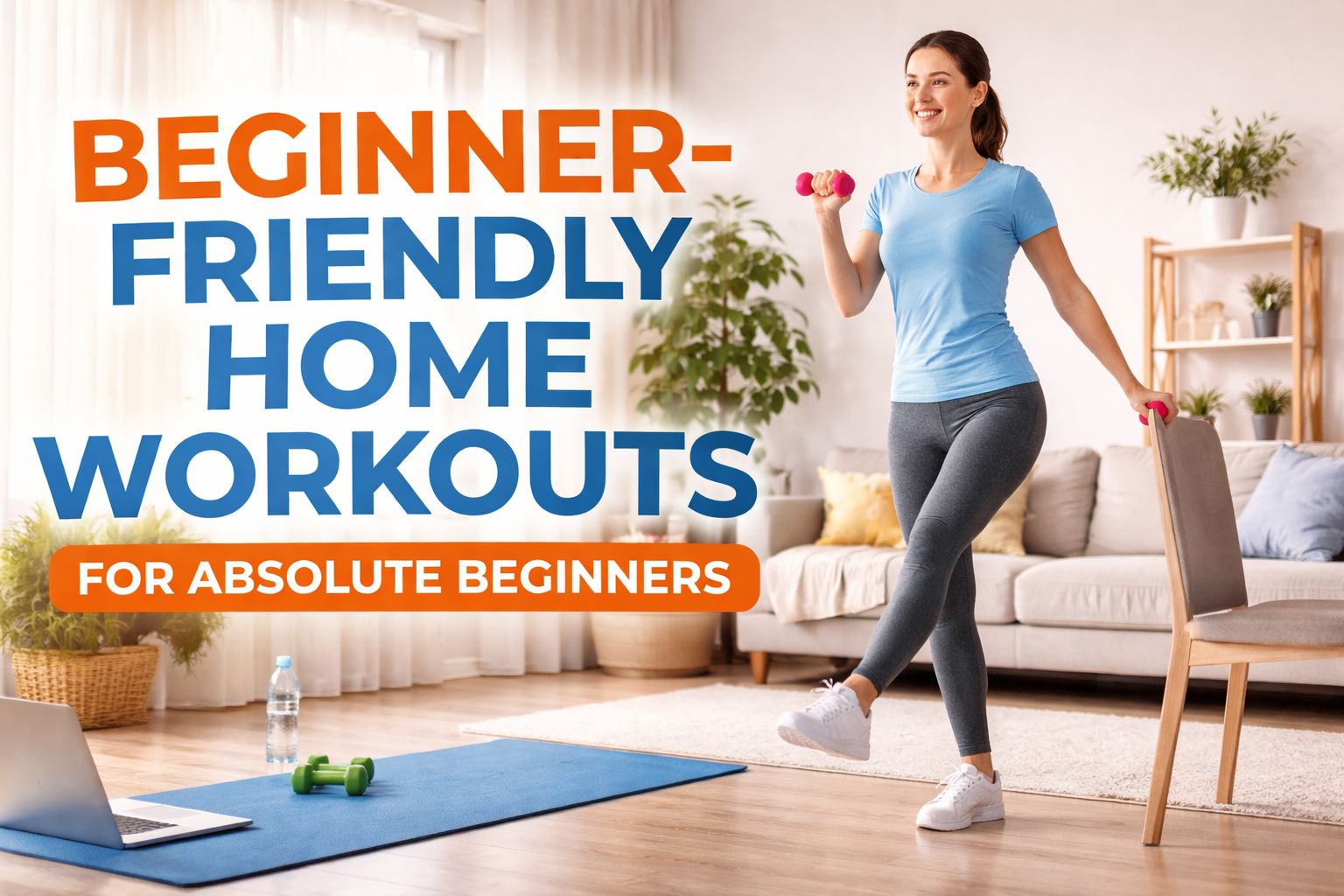
You are currently viewing 12 Beginner-Friendly Home Workouts for Absolute Beginners (Step-by-Step) in 2026

12 Beginner-Friendly Home Workouts for Absolute Beginners (Step-by-Step) in 2026

Starting a new fitness habit can feel overwhelming. Gym memberships, complicated machines, and high-energy classes aren’t for everyone — especially if you’re new to exercise, returning after a long break, or prefer staying at home. Good news: a sustainable home workout for beginners is simple, effective, and available to people of every age and fitness level.
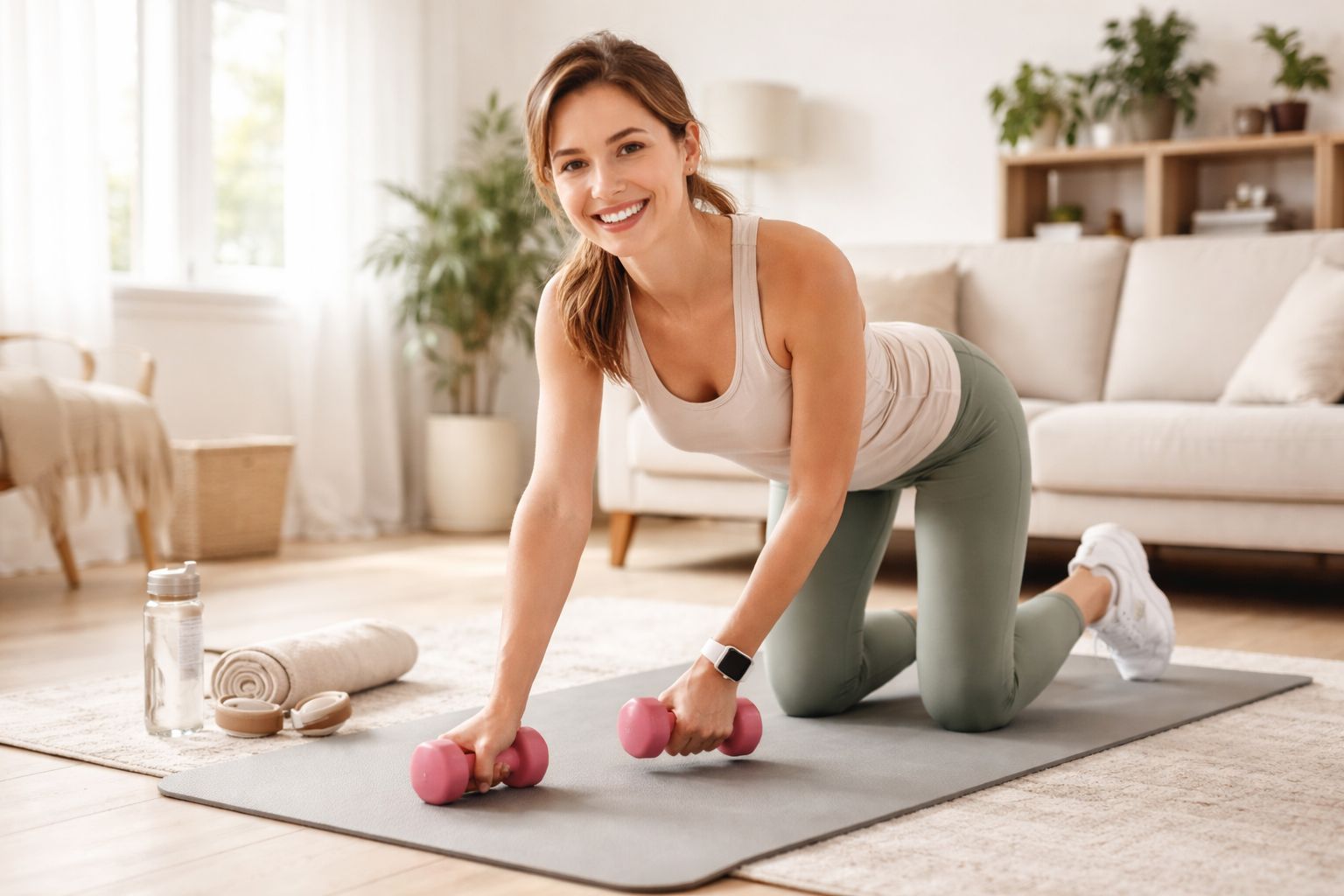
Smiling beginner woman exercising in a bright living room, performing a low-impact workout with natural sunlight and minimal equipment.
A happy beginner working out at home with a simple, low-impact move—perfect for boosting energy and motivation.


This guide gives you 12 beginner-friendly exercises you can do at home with zero equipment. Each exercise includes step-by-step instructions, common mistakes to avoid, and easy modifications for seniors, people with joint pain, or absolute beginners. You’ll also get safety tips, a sample 3- and 5-day weekly plan, and FAQs optimized to answer the questions new exercisers ask most.

Why focus on home workouts? They remove barriers: no commute, no intimidating gym environment, and you can start in a single room with just a chair and a wall. Whether you’re a teen, a busy parent, or someone in their 60s, this plan gives you gentle, progressive exercises to build strength, flexibility, balance, and confidence. Stick with the simple routines here, and you’ll notice improvements in energy, mood, mobility, and — with time and consistency — strength and body composition.

Ready to get started? The exercises below are ordered from very gentle to slightly more challenging. Read the safety and preparation section first, then pick a few exercises to try today.
Why Home Workouts Are Perfect for Absolute Beginners

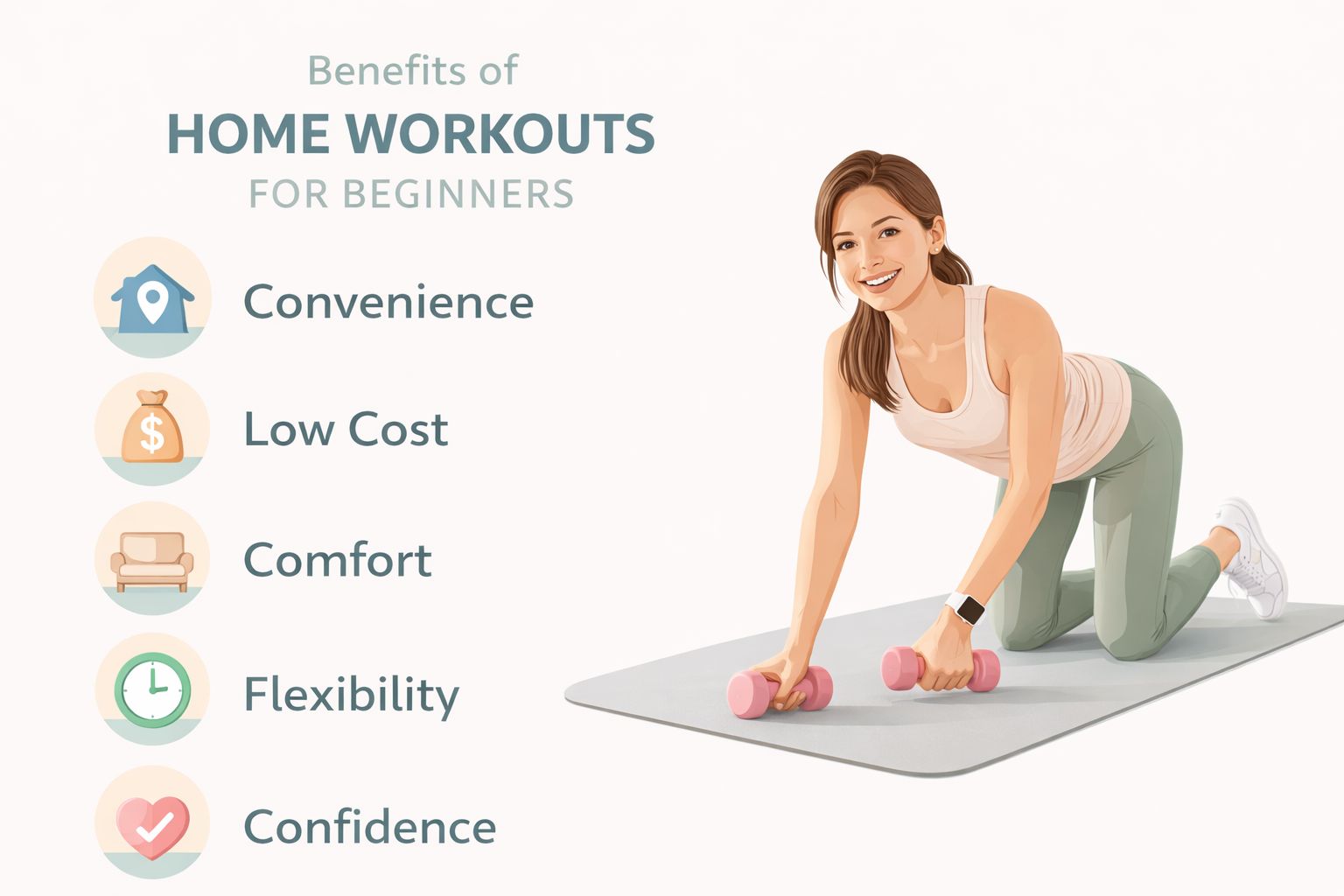
Illustration of a woman exercising at home on a yoga mat beside an infographic listing the benefits of home workouts for beginners, including convenience, low cost, comfort, flexibility, and confidence.

Home workouts are ideal for beginners because they:

  • Fit busy schedules — no travel time.
  • Remove gym intimidation and social anxiety.
  • Cost nothing — bodyweight moves and household props work fine.
  • Are easier to adjust for mobility, pain, or age.
  • Help build consistency — doing something 15–20 minutes per day beats sporadic long sessions.

For beginners, the goal is consistency and good form. Frequent short sessions are better than rare, intense workouts. This guide gives you safe progressions and modifications so you can start small and build up.

Before You Start: Beginner Safety & Preparation Tips

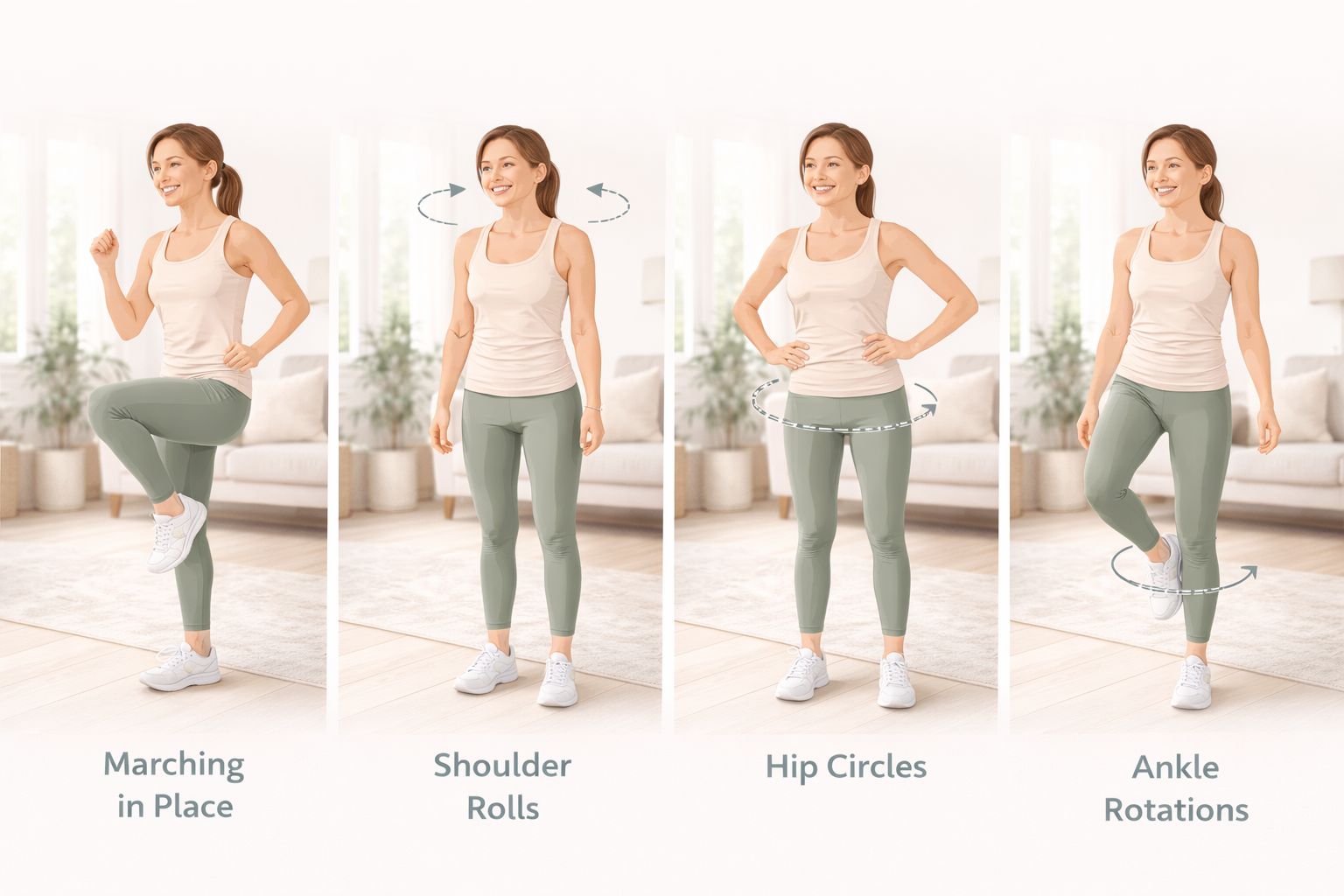
Beginner performing gentle warm-up exercises at home, including marching, shoulder rolls, and hip circles, in a bright and clean living room.
  • Warm up (3–7 minutes): Light marching, shoulder rolls, ankle circles, and gentle hip swings prepare your joints and increase blood flow.
  • Breathing basics: Breathe steadily — exhale on effort (e.g., when standing from a squat), inhale on relaxation. Don’t hold your breath.
  • Start slow: Begin with 1–2 sets of each exercise or 30–60 seconds, and build gradually.
  • Listen to your body: Mild muscle soreness is normal; sharp pain is not. Stop if you feel dizziness, intense joint pain, or chest pain.
  • Medical note: If you have chronic conditions (heart disease, uncontrolled high blood pressure, recent surgeries), check with a healthcare professional before starting a new exercise program.
  • Environment: Clear a small space, wear comfortable clothing and supportive shoes (or go barefoot on a non-slip mat), and keep water nearby.

How This Beginner Home Workout Plan Works

  • Frequency: Aim for 3–5 days per week. Start with 3 days if you’re very new, then add days as you feel ready.
  • Session length: 15–30 minutes per session.
  • Reps & sets: For beginners: 8–12 reps for strength-style moves, 30–60 seconds for holds and balance moves. Begin with 1–2 sets and progress to 2–3 sets over weeks.
  • Rest: 30–90 seconds between sets or exercises, depending on effort.
  • Progression: Add 5–10 seconds to hold times, add 1–3 reps per week, or add another set when an exercise feels easy.
  • Modifications: Each exercise includes easier and harder variations for different ages and abilities.

12 Beginner-Friendly Home Workouts (Step-by-Step)

1. Marching in Place

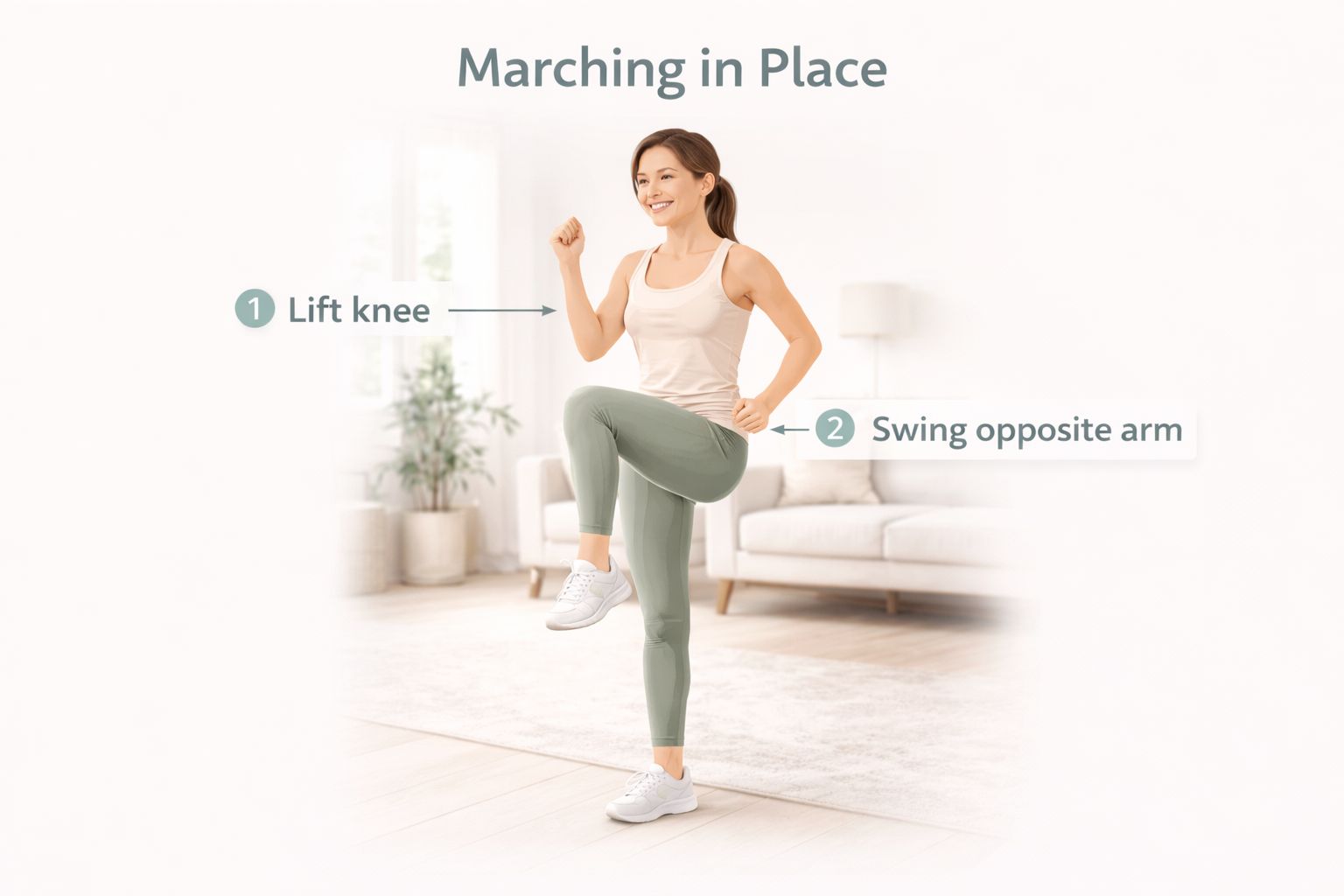
A beginner demonstrating the marching in place exercise with controlled knee lifts and arm swings in a home environment.

Targets: Cardiovascular system, hip flexors, calves — gentle warm-up cardio.

Why it’s great: Low impact, easy to adjust intensity, suitable for all ages.

How to do it (step-by-step):

  1. Stand tall with feet hip-width apart, knees soft (not locked).
  2. Gently lift your right knee to hip height or as high as comfortable, swinging the left arm forward.
  3. Lower the right foot and lift the left knee, swinging the right arm.
  4. Continue alternating at a comfortable rhythm.

Beginner’s tips: Keep core engaged, relax shoulders, and use a chair for balance if needed. Start 30–60 seconds and work up to 3–5 minutes.

Common mistakes: Hunching the shoulders, holding breath, stomping. Keep movements controlled and rhythmic.

2. Wall Push-Ups

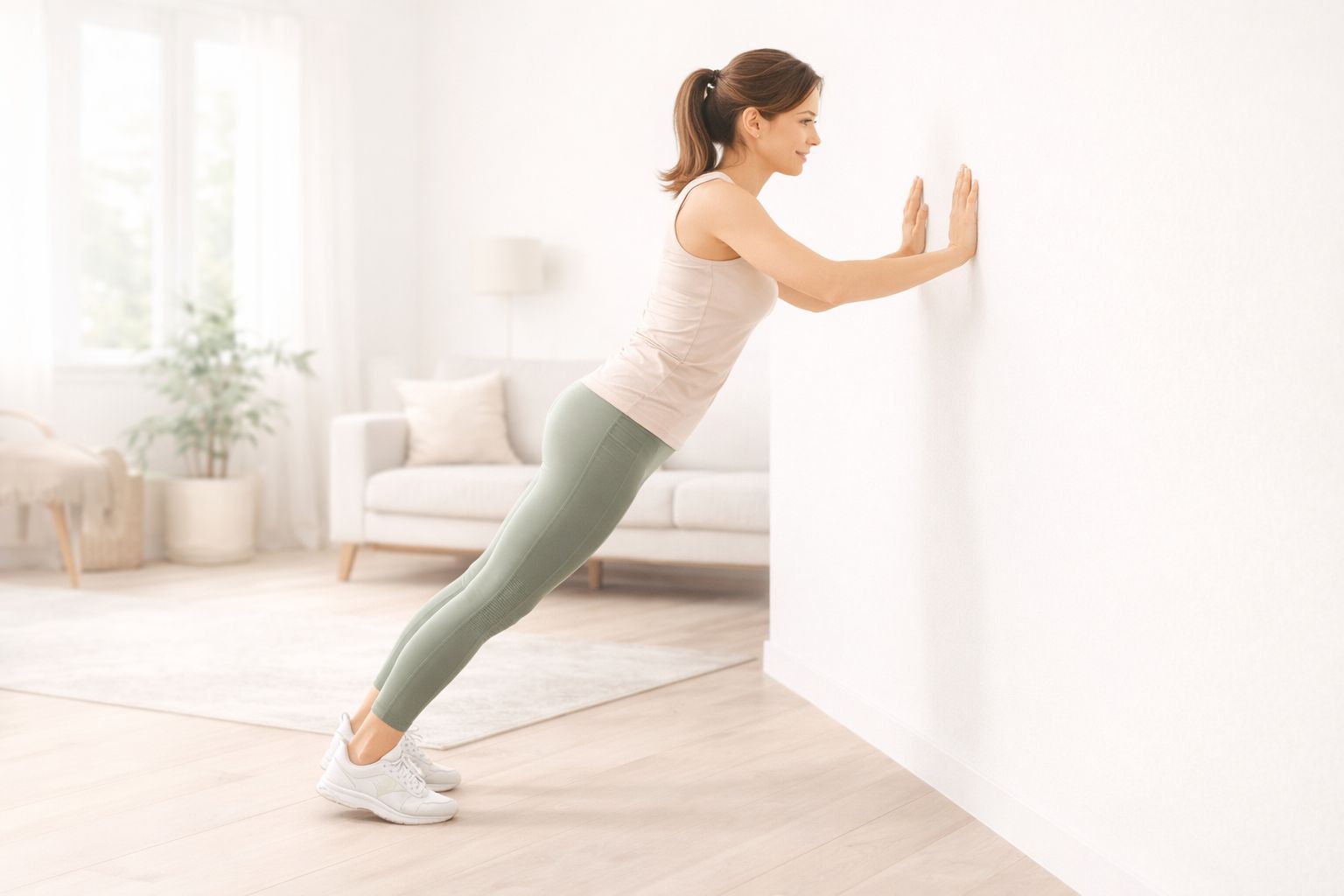
Beginner performing wall push-ups with straight body alignment and hands pressed against the wall.

Targets: Chest, shoulders, triceps, core. A beginner-friendly upper-body push exercise.

How to do it (step-by-step):

  1. Stand facing a wall about an arm’s length away.
  2. Place palms on the wall at shoulder height and shoulder-width apart.
  3. Keep your body straight from head to heels. Bend elbows to lower chest toward the wall.
  4. Push back to the starting position.

Reps/sets: 8–12 reps, 1–3 sets.

Progressions: Move feet further from the wall for a stronger challenge; eventually progress to incline push-ups (hands on a sturdy table or counter), and then to floor push-ups.

Common mistakes: Letting hips sag or piking up. Keep a straight line and tighten the core.

3. Chair Squats

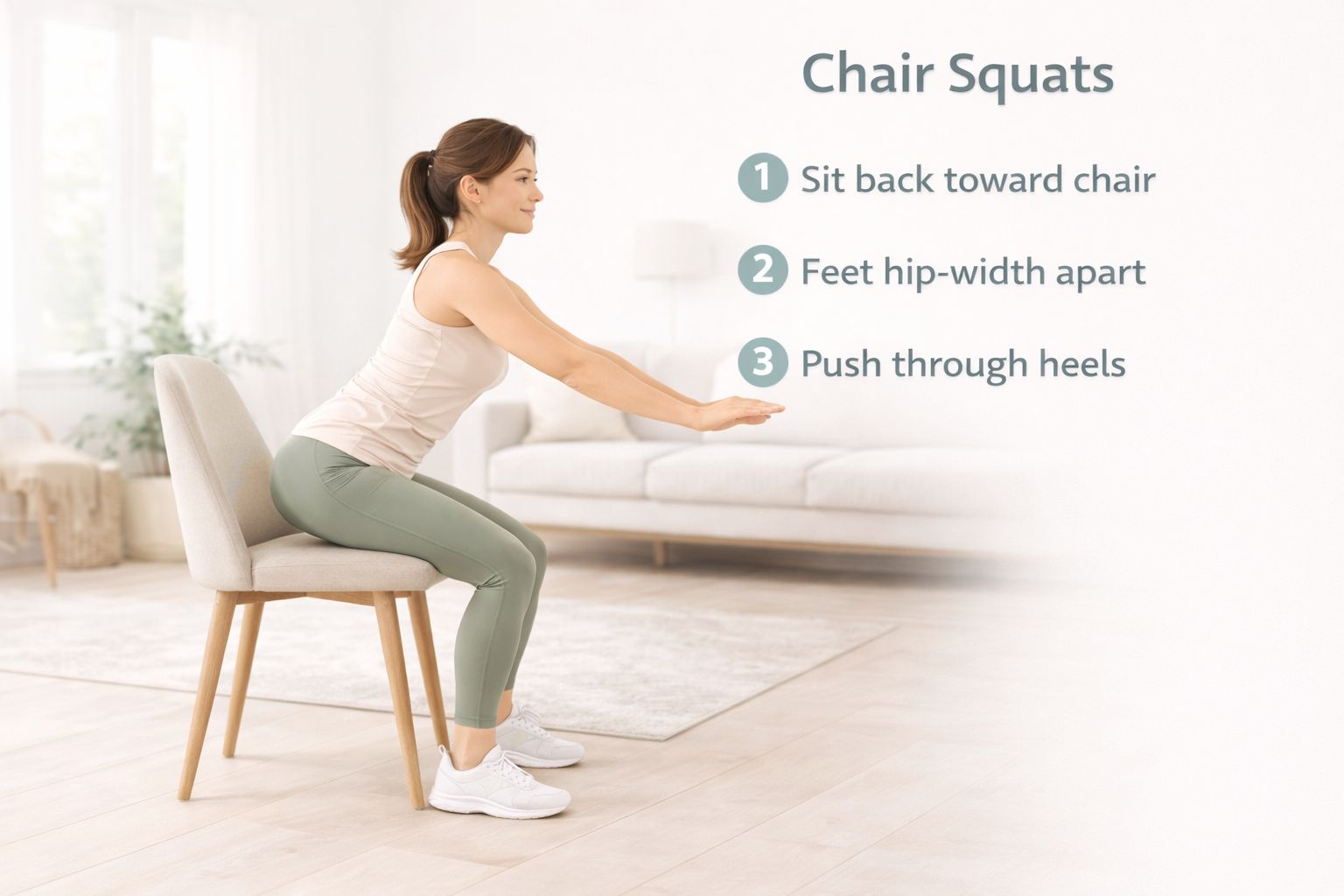
Beginner doing chair squats with proper form, sitting back toward a chair, and standing up using heel drive.

Targets: Quadriceps, glutes, hamstrings, core. Great for building lower-body strength safely.

How to do it (step-by-step):

  1. Stand in front of a chair with feet hip-width apart.
  2. Keep chest up, core braced. Reach your hips back and bend your knees as if sitting down.
  3. Lightly touch the chair with your glutes (don’t plop down) and stand back up by pushing through your heels.

Reps/sets: 8–12 reps, 1–3 sets.

Modifications: Use a higher chair for an easier version. Add a pause at the top or hold for 1–2 seconds to increase difficulty.

Common mistakes: Knees caving inward, leaning too far forward, or sitting fully (losing engagement). Keep weight on heels and knees aligned with toes.

4. Standing Arm Circles

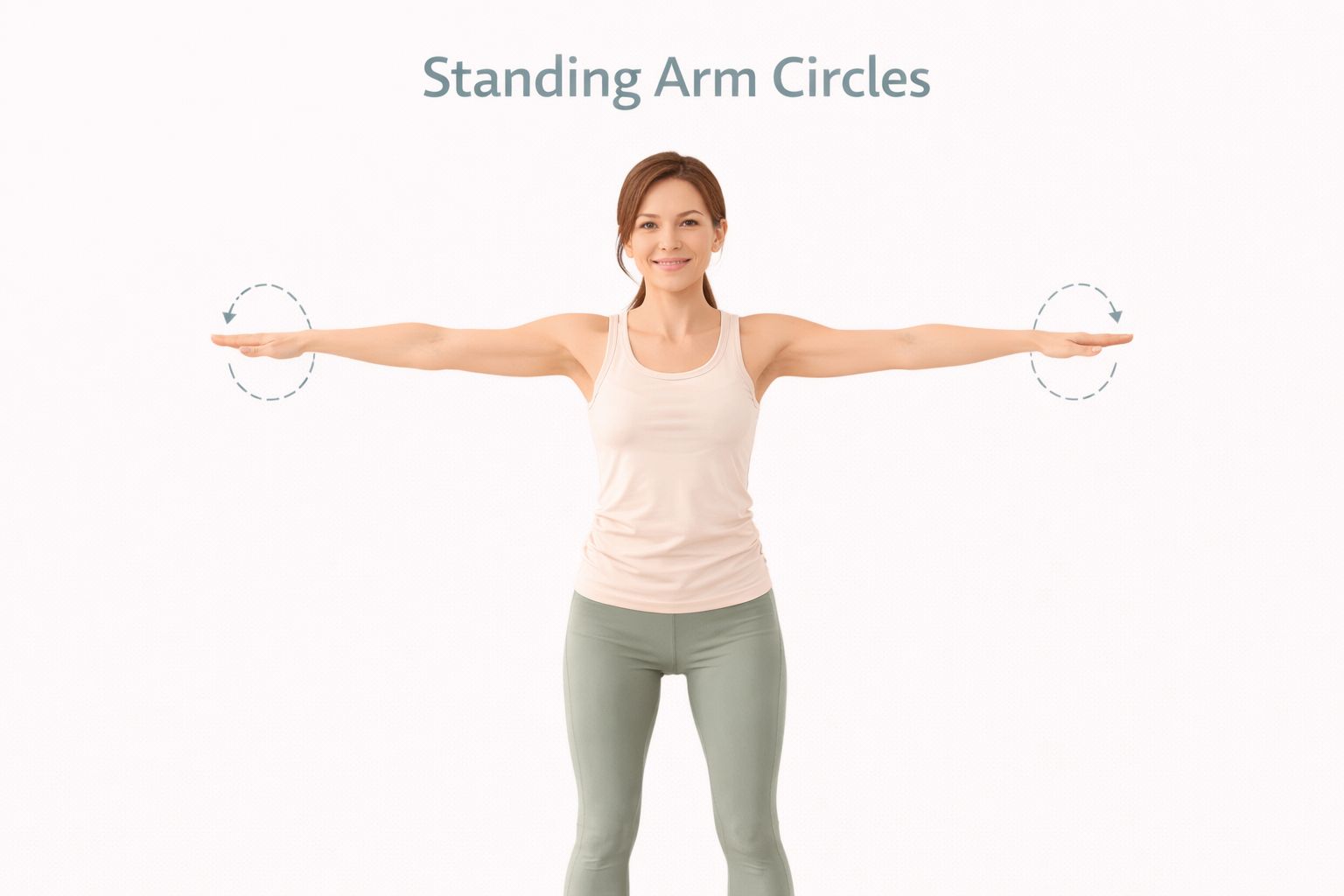
Beginner performing small controlled arm circles with arms extended at shoulder height.

Targets: Shoulder mobility and endurance, upper back stability.

How to do it (step-by-step):

  1. Stand tall, arms extended out to the sides at shoulder height, palms down.
  2. Make small circles forward for 20–30 seconds, then reverse for 20–30 seconds.
  3. Keep movements controlled; stop if you feel sharp shoulder pain.

Beginner’s tips: Start with small circles and increase circle size slowly. Use a seated position if balance is a concern.

Common mistakes: Shrugging shoulders or using the neck. Keep neck relaxed and shoulder blades engaged.

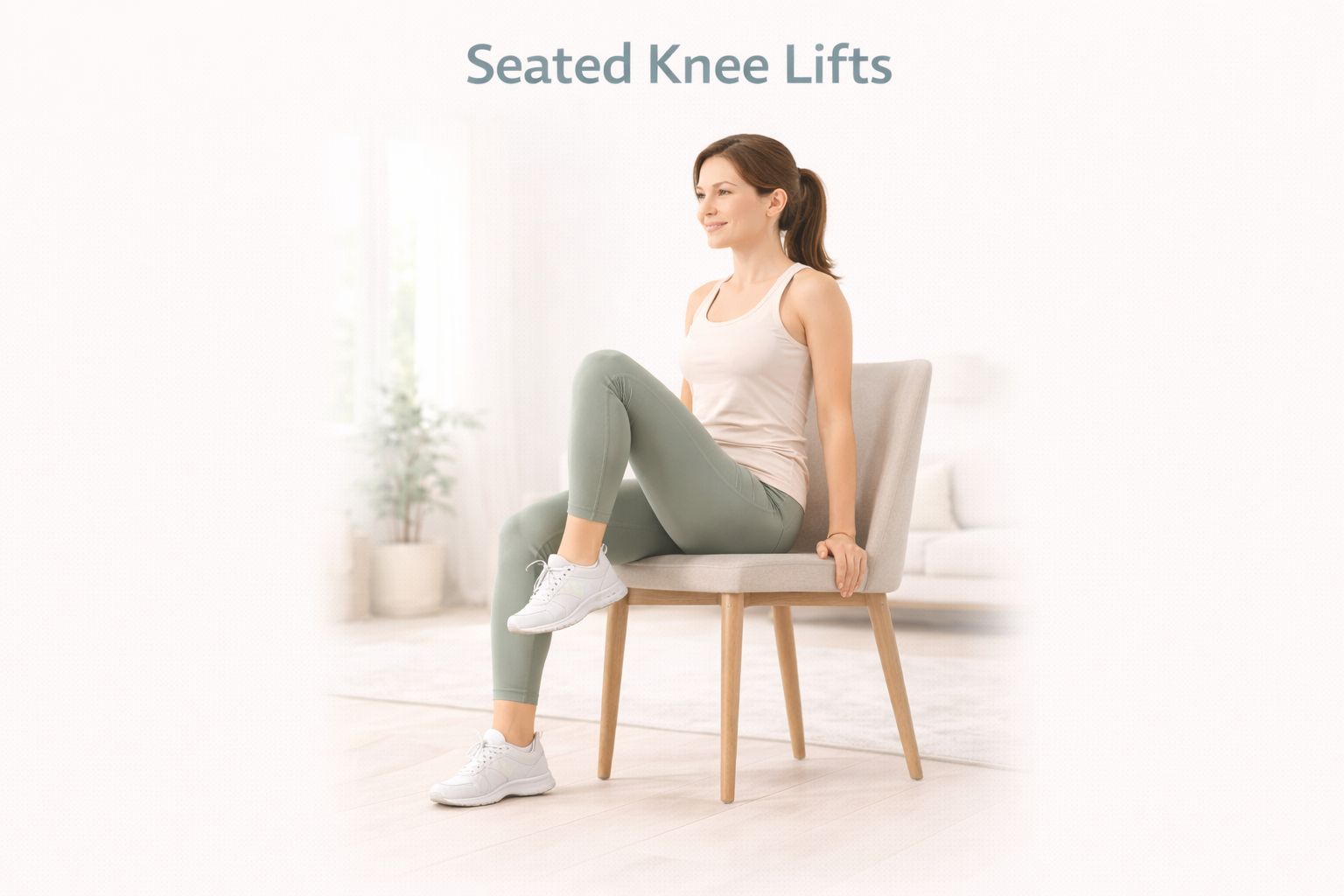
5. Seated Knee Lifts

Beginner seated on a chair, lifting knees alternately to engage the core and hip flexors.

Targets: Core, hip flexors, lower abs — gentle core activation.

How to do it (step-by-step):

  1. Sit on the edge of a sturdy chair with feet flat on the floor.
  2. Hold onto the sides of the chair. Keep your back straight.
  3. Slowly lift one knee toward your chest, lower it, then lift the other.
  4. Alternate at a steady pace.

Reps/sets: 10–15 lifts per leg, 1–3 sets. Or 30–45 seconds continuous alternating.

Variations: For more challenge, perform seated marches faster or lift both knees together slightly.

Common mistakes: Leaning back; use your abs, not momentum.

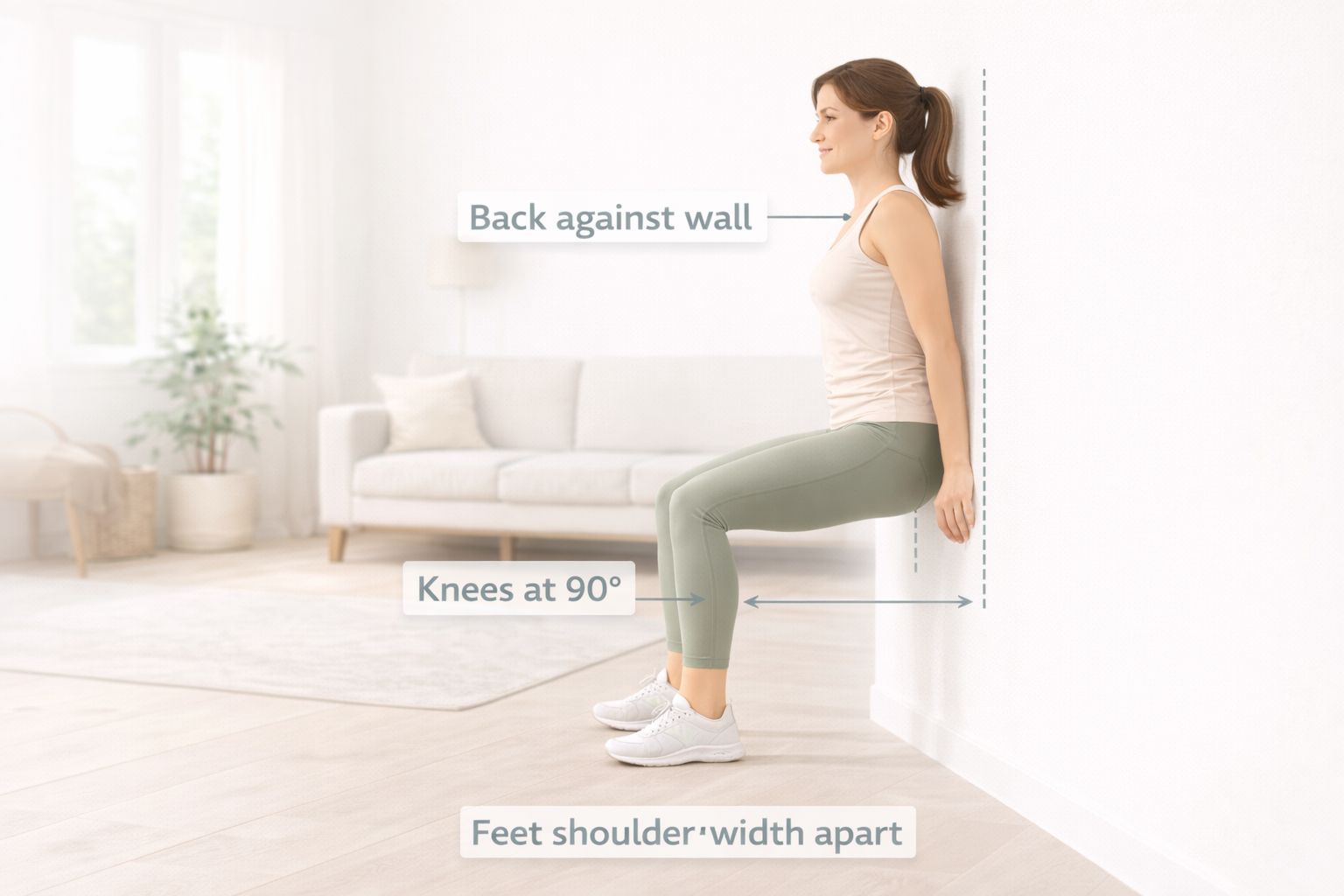
6. Wall Sit Hold

Beginner performing a wall sit with thighs parallel to the ground and back pressed against the wall.

Targets: Quadriceps endurance, glutes, core stabilization.

How to do it (step-by-step):

  1. Stand with your back against a wall, feet about 1–2 feet away.
  2. Slide down until hips are roughly at knee level (like sitting on an invisible chair).
  3. Hold the position for 10–30 seconds to start, focusing on breathing.

Reps/sets: 2–4 holds of 10–45 seconds, depending on ability.

Progressions: Hold longer, extend to 1 minute, or shift weight side to side to increase challenge.

Common mistakes: Letting knees go past toes; keep knees in line with ankles as much as possible.

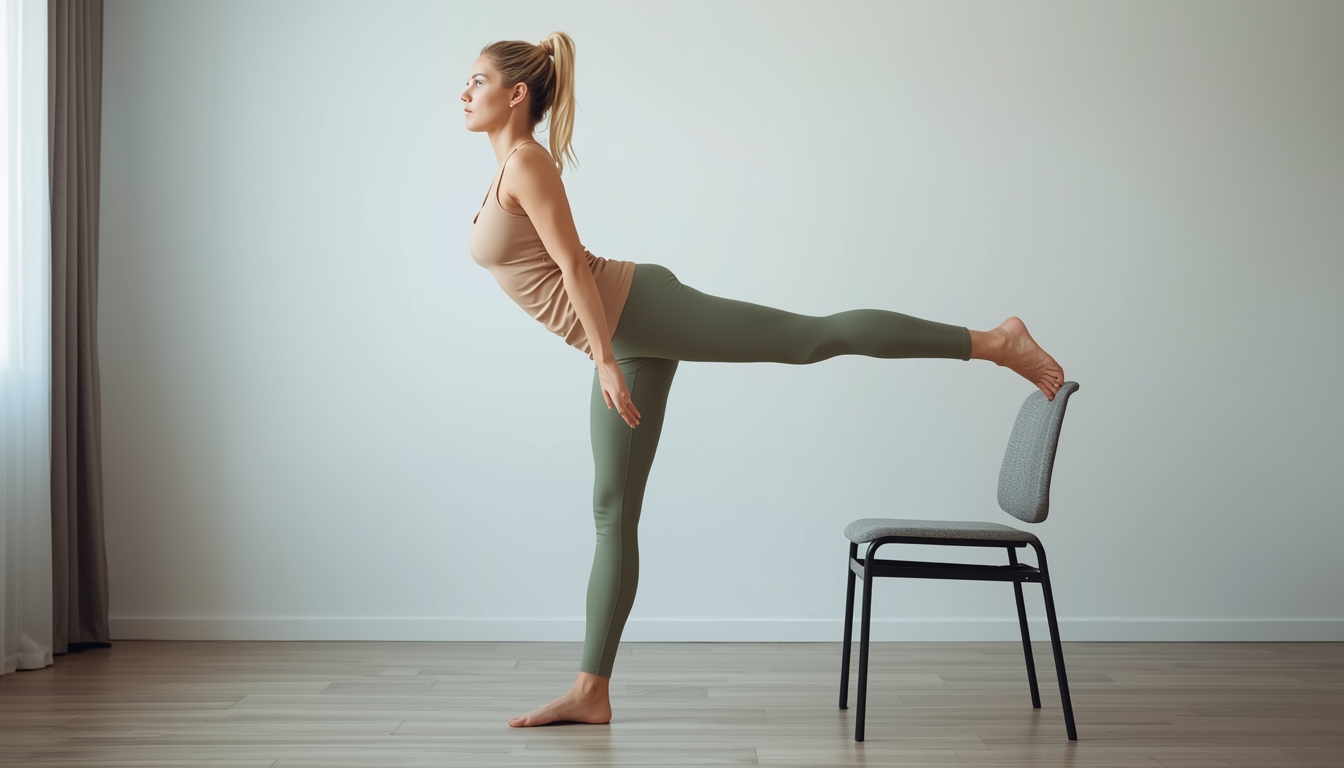
7. Standing Side Leg Raises

Beginner lifting leg sideways while holding onto a chair for balance.

Targets: Hip abductors, balance, glutes — important for walking stability and lower-body strength.

How to do it (step-by-step):

  1. Stand tall, holding a chair or wall for support.
  2. Shift weight to the left leg; lift the right leg straight out to the side (don’t lean).
  3. Lower with control and repeat, then switch sides.

Reps/sets: 10–15 reps per leg, 1–3 sets.

Modifications: Bend the raised knee slightly if the straight leg is uncomfortable. For more challenge, add ankle weights or slow the tempo.

Common mistakes: Tilting the torso, swinging the leg. Keep upright and controlled.

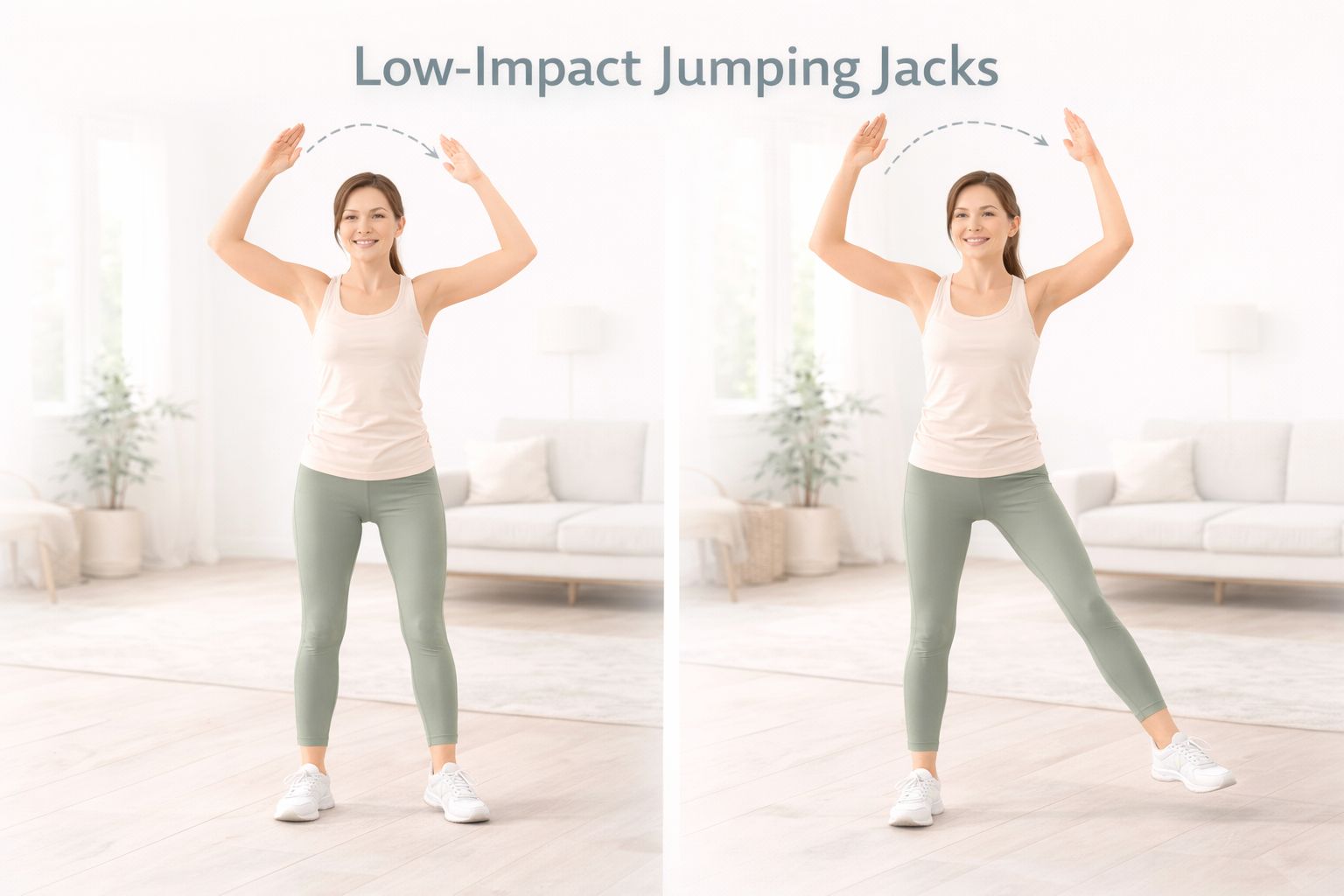
8. Modified Jumping Jacks (Low Impact)

Beginner performing step-out jumping jacks with arms raised overhead in a low-impact style.

Targets: Light cardio, coordination. Low-impact version avoids joint stress.

How to do it (step-by-step):

  1. Stand with feet together and arms at sides.
  2. Step right foot out to the side while raising arms overhead (or to shoulder height).
  3. Step left foot back to the center while lowering arms.
  4. Repeat alternating sides in a rhythmic march pattern.

Time: 30–60 seconds per set; 2–4 sets.

Progressions: Add faster tempo or small hops as fitness improves. Keep knees soft.

Common mistakes: Locking knees or landing hard. Maintain soft landings and a light bounce if you include it.

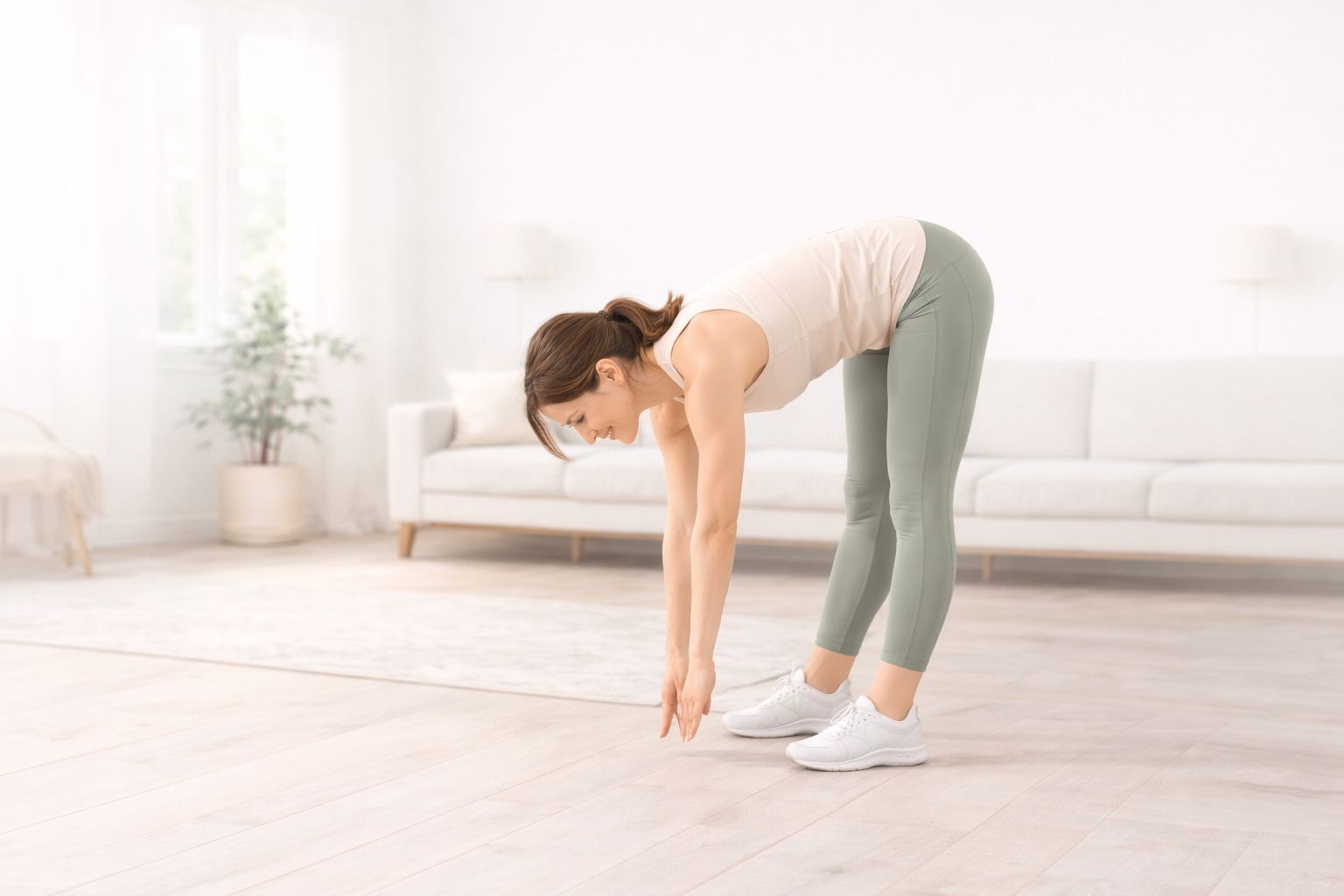
9. Standing Toe Touch Stretch

Beginner bending forward with a hip hinge to reach toward the toes, stretching the hamstrings.

Targets: Hamstrings and lower-back flexibility.

How to do it (step-by-step):

  1. Stand tall with feet hip-width apart.
  2. Hinge at the hips (not rounding the lower back), reach toward toes or shins.
  3. Hold for 20–30 seconds, breathing into the stretch.

Variations: Bend knees slightly to reduce pull on hamstrings. For a deeper stretch, reach for your toes and hold longer.

Safety: Never force a stretch. Feeling a mild pull is okay — sharp pain is not.

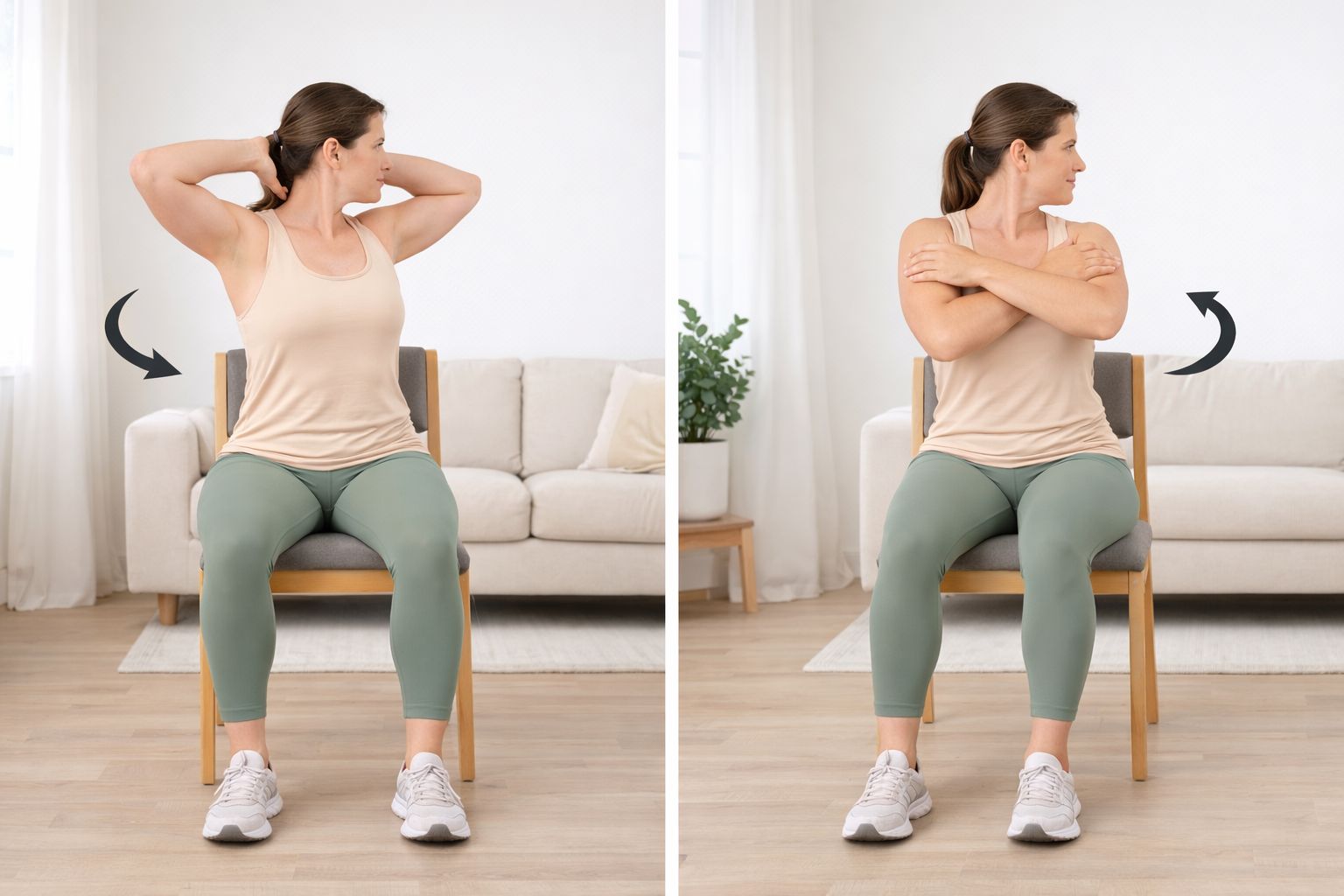
10. Seated Torso Twists

Beginner seated on a chair, twisting the torso gently from side to side to improve spine mobility.

Targets: Core rotation, spine mobility, oblique engagement.

How to do it (step-by-step):

  1. Sit tall on a chair with feet flat on the floor.
  2. Place your hands lightly behind your head or cross them over your chest.
  3. Twist gently to the right, return to the center, then twist left.
  4. Keep movement controlled — don’t jerk.

Reps/sets: 10–12 twists per side, 1–3 sets.

Modifications: Reduce the range of motion if you have lower back issues. Keep hips facing forward.

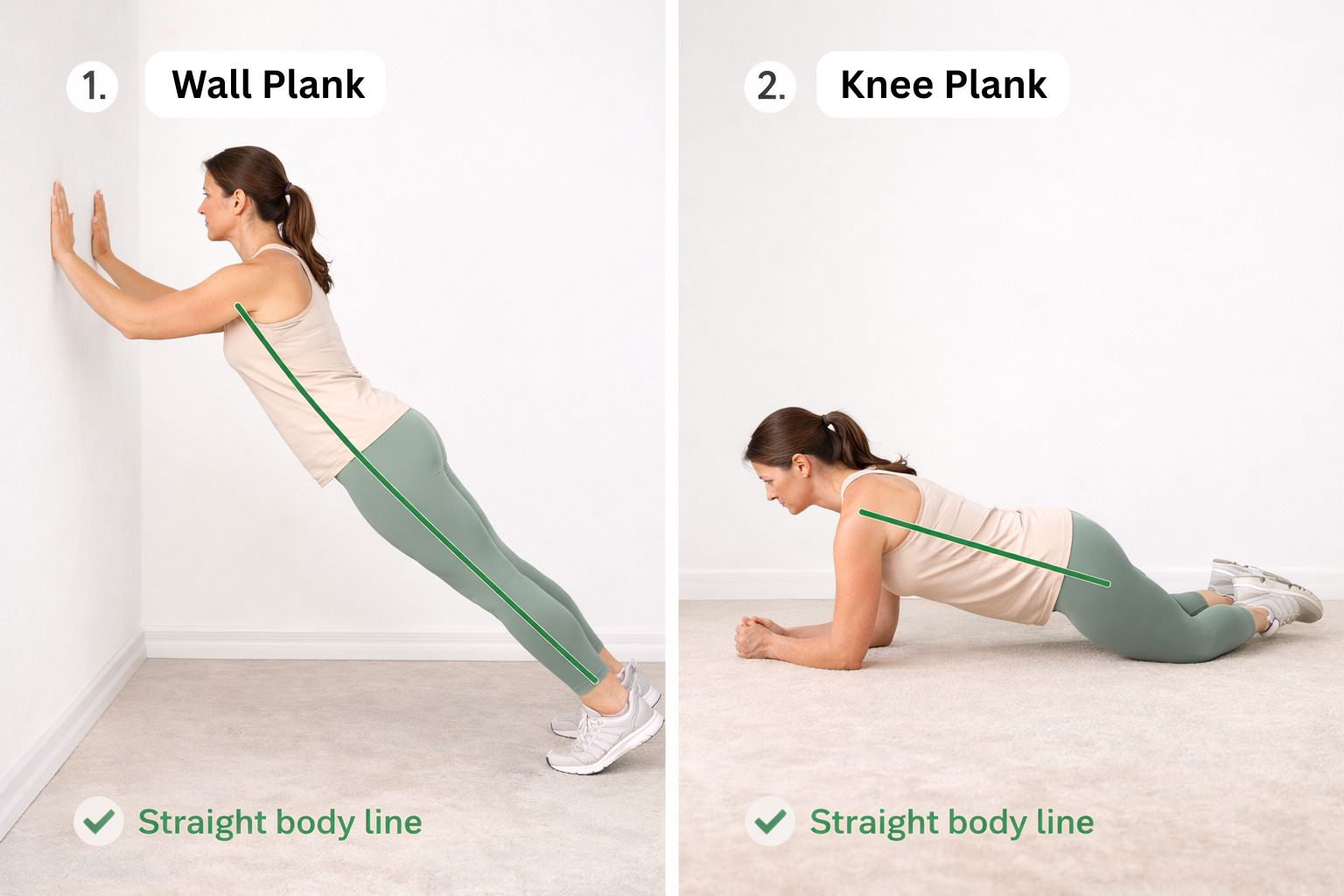
11. Beginner Plank (Wall or Knees)

Two beginners performing wall plank and knee plank variations with straight alignment and controlled posture.

Targets: Core, shoulders, and back stability.

Wall Plank (step-by-step):

  1. Stand facing a wall and place forearms or palms on the wall.
  2. Walk feet back until body forms a straight line (or a slight incline).
  3. Hold for 10–30 seconds to start.

Knee Plank (on floor) (step-by-step):

  1. Kneel and place forearms on the floor shoulder-width apart.
  2. Walk knees back and lift hips so body forms a straight line from head to knees.
  3. Hold for 10–30 seconds.

Progression: Move from wall to knee plank to full floor plank on toes.

Common mistakes: Letting hips sag or shoulders collapse. Maintain a neutral spine and tight core.

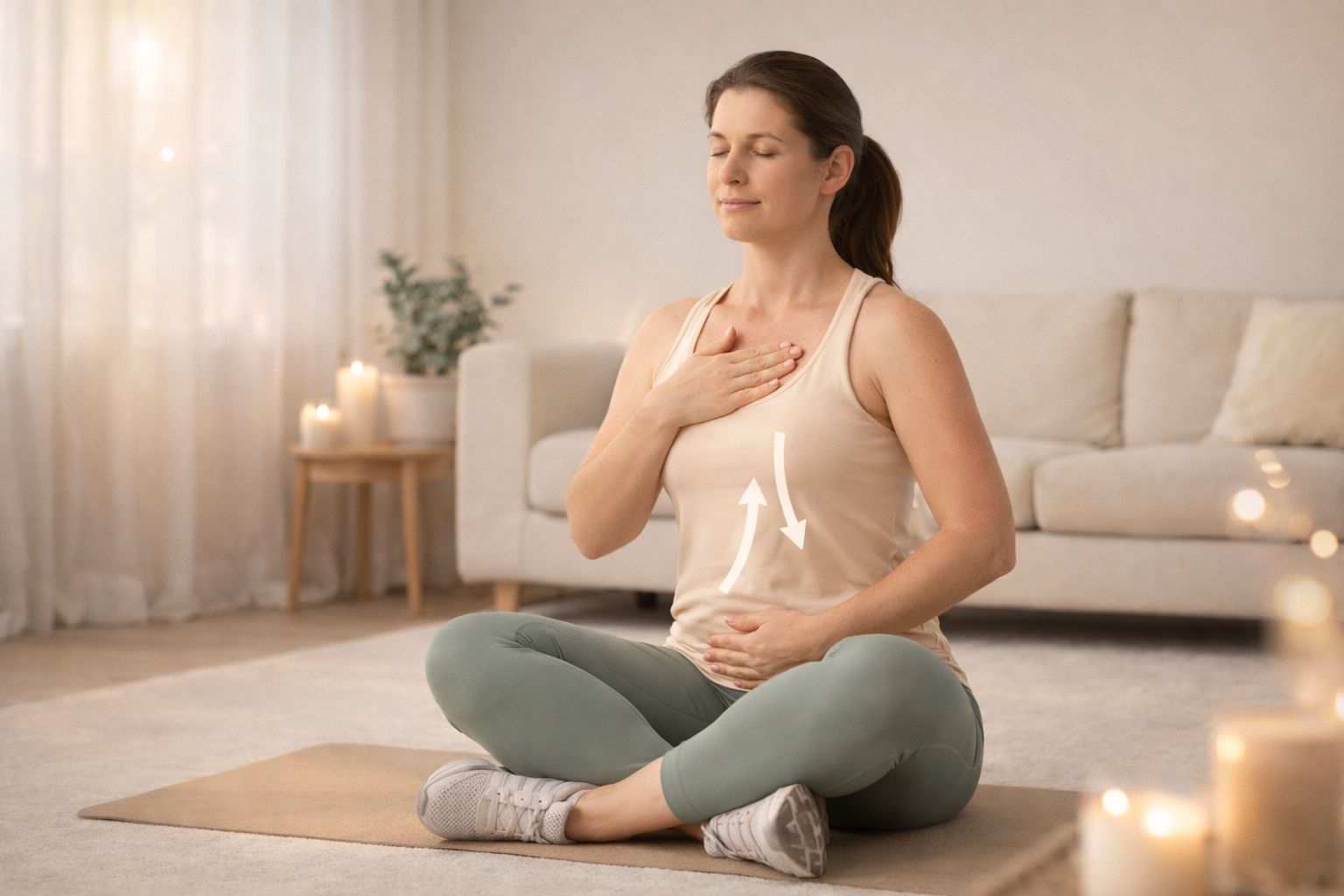
12. Deep Breathing Cool-Down

Beginner sitting cross-legged in a calm living room, practicing slow, with deep breathing.

Targets: Nervous system regulation, recovery, and stress reduction.

How to do it (step-by-step):

  1. Sit or lie down comfortably.
  2. Inhale slowly through the nose for a count of 4 (or a comfortable count).
  3. Pause briefly and exhale slowly through the mouth for a count of 6–8.
  4. Repeat for 1–3 minutes until breathing slows and heart rate lowers.

Benefits: Lowers cortisol, helps muscle relaxation, and improves recovery.

Beginner Weekly Home Workout Plan

Here are two sample weekly plans — a gentle 3-day plan and a slightly more active 5-day plan. Both use the exercises above and are suitable for most beginners. Choose the plan that fits your schedule and energy level.
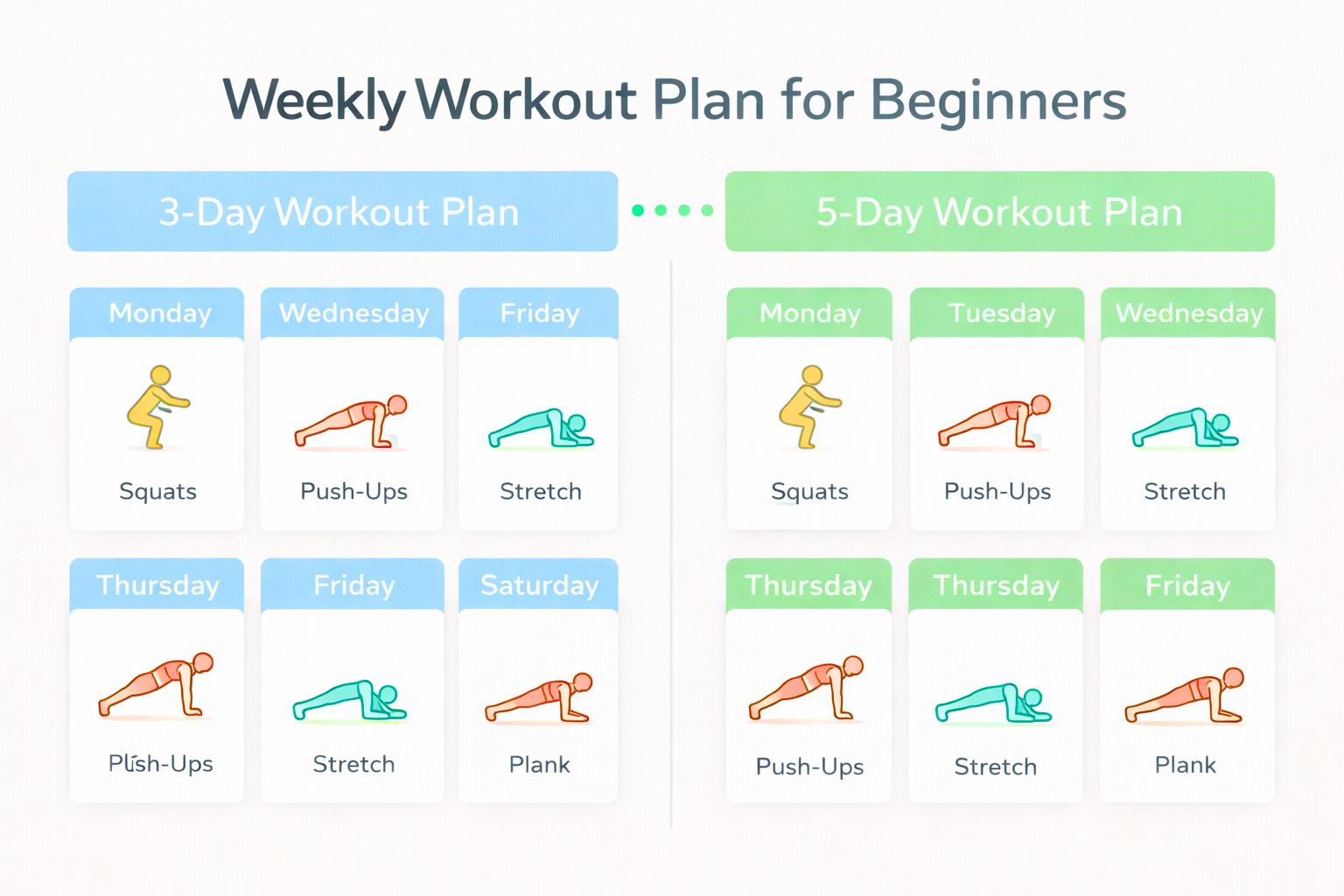
Infographic displaying a beginner-friendly weekly workout schedule, including strength, mobility, and cardio days.
A simple weekly workout plan outlining beginner-friendly exercise routines.


3-Day Plan (Ideal to start)

Day 1: Strength + Mobility (20–25 min)

Warm-up: March in place — 3 minutes

  • Chair Squats — 2 sets of 10–12
  • Wall Push-Ups — 2 sets of 8–12
  • Standing Side Leg Raises — 2 sets of 10 per side
  • Seated Torso Twists — 2 sets of 10 per side

Cool-down: Deep breathing — 2 minutes

Day 2: Active Recovery (15–20 min)

Warm-up: Arm circles + marching — 3–5 minutes

  • Modified Jumping Jacks (low impact) — 3 sets of 30–45 seconds
  • Seated Knee Lifts — 2 sets of 15 per leg
  • Standing Toe Touch Stretch — 30 seconds hold x 2

Cool-down: Deep breathing — 2 minutes

Day 3: Strength + Balance (20–25 min)

  • Warm-up: Marching + shoulder rolls — 3 minutes
  • Wall Sit Hold — 3 holds of 10–30 seconds
  • Beginner Plank (wall or knees) — 2 holds of 15–30 seconds
  • Standing Arm Circles — 3 x 20 seconds forward + 20 seconds reverse

Cool-down: Deep breathing — 2 minutes

5-Day Plan (For faster habit-building)

Day 1: Strength (same as Day 1 above)
Day 2: Mobility & Light Cardio (marching + low-impact jacks + stretches)
Day 3: Strength (lower-body focused: chair squats, wall sits, leg raises)
Day 4: Active recovery (walking, light stretching)
Day 5: Full-body (short circuit combining push-ups, squats, planks, seated knee lifts)

Weekend: Rest or light walking, stretching, or yoga
Common Beginner Mistakes to Avoid

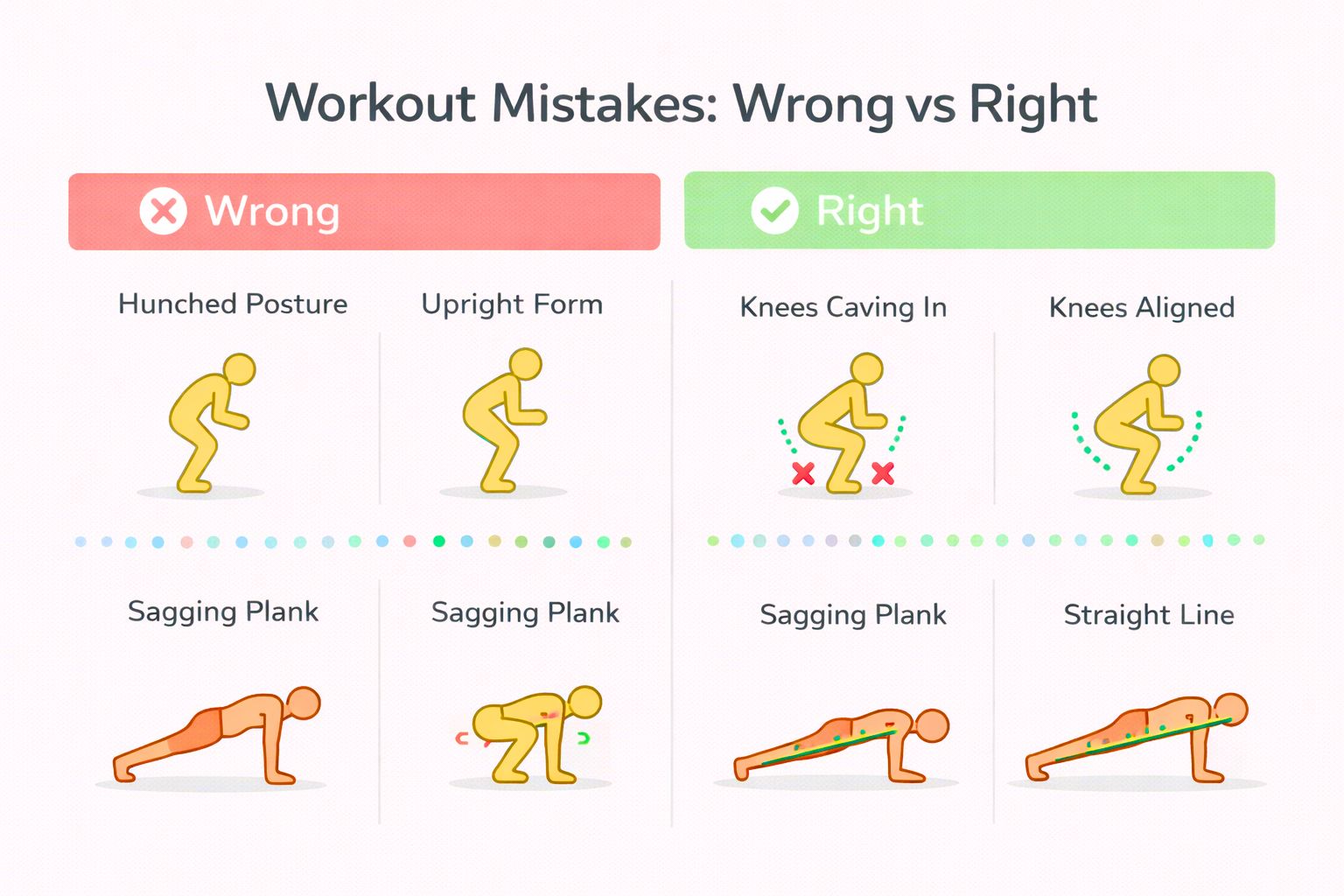
Illustration comparing incorrect and correct exercise form for common beginner workout mistakes.
  • Doing too much too soon: Start small. It’s better to be consistent with short sessions than to burn out after a long workout.
  • Skipping warm-ups: Cold muscles are more injury-prone.
  • Poor form: Quality beats quantity. Reduce reps or speed to preserve form.
  • Ignoring rest and recovery: Overtraining causes setbacks and fatigue.
  • Compared to others: Everyone’s starting point is different. Progress at your own pace.
  • Neglecting nutrition & hydration: Exercise works best with balanced meals and enough water.

#Learn about Common Home Workout Mistakes That Stop Weight Loss – Fix Them and Start Losing 2026


How Long Before Beginners See Results?

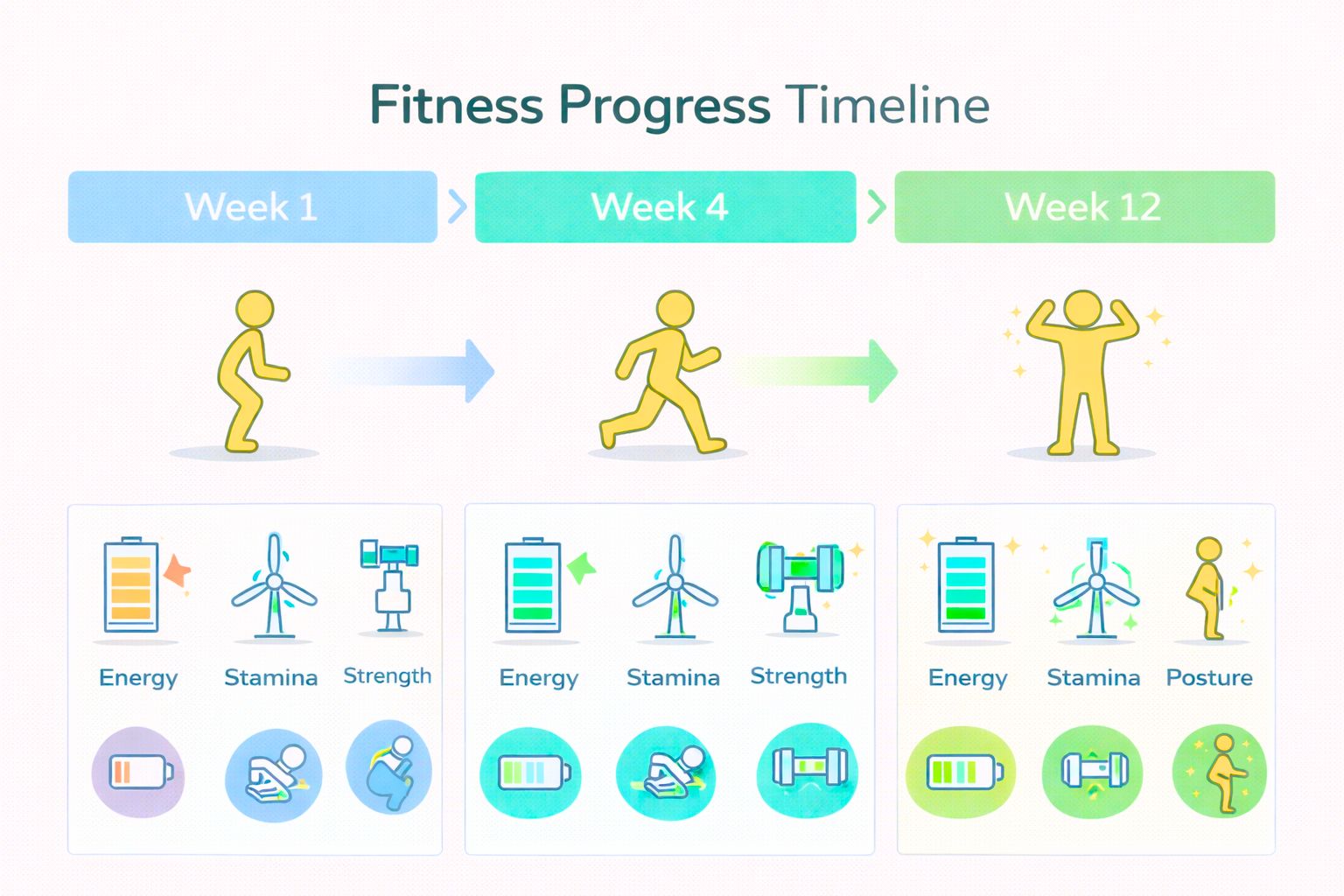
Infographic showing typical fitness progress from week 1 to week 12, including stamina, strength, energy, and posture improvements

Results vary based on baseline fitness, diet, sleep, and consistency. Typical timelines:

  • 1 week: Small improvements in mood, sleep, and energy.
  • 2–4 weeks: Increased stamina, less fatigue during daily activities, basic coordination improvements.
  • 8–12 weeks: Noticeable strength gains, better posture, improved balance, and some changes in body composition with dietary changes.

Long-term: Sustained improvements in cardiovascular health, strength, mobility, and mental well-being with consistent training and healthy habits.

Remember: Non-scale victories — better sleep, easier stairs, less back pain — often arrive before visible changes in weight.

Home Workout Tips for Different Age Groups

Teens: Focus on learning good movement patterns. Keep workouts varied and fun to build a lifelong habit. Avoid heavy loads without supervision.

Adults (20s–50s): Aim for a mix of cardio, strength, and mobility. Prioritize consistent short sessions if busy.

Seniors (60+): Emphasize balance, mobility, low-impact strength (chair squats, wall push-ups), and flexibility. Use supports for stability and check with a physician if you have chronic conditions.

Overweight beginners: Start with low-impact (marching, chair squats, wall push-ups). Increase duration before intensity to build endurance.

Adapt the exercises above to individual needs — everyone benefits from movement tailored to their body.

FAQs — Home Workout for Beginners

  1. Is a home workout good for beginners?
    A: Yes. Home workouts are excellent for beginners because they’re convenient, low-cost, and easily modified for different fitness levels.

  2. How many minutes should beginners work out at home?
    A: Start with 15–20 minutes per session and aim for 3 sessions per week. Gradually increase to 25–40 minutes and 4–5 sessions as fitness improves.

  3. Can beginners lose weight with home workouts?
    A: Yes—combined with a calorie-aware, balanced diet, regular home workouts can help create the calorie deficit needed for weight loss. Strength training and increasing daily activity are especially helpful.

  4. Do I need equipment for home workouts?
    A: No. Many effective beginner exercises use body weight and household props (chair, wall). A resistance band or light dumbbells can be helpful, but are not required.

  5. Is a home workout safe for seniors?
    A: Generally, yes, especially when exercises are modified for balance and joint health (chair squats, wall push-ups, seated knee lifts). Seniors should consult a healthcare provider if they have medical concerns.

  6. How often should beginners increase intensity?
    A: Aim to increase volume or intensity every 1–3 weeks, depending on comfort. Add reps/time gradually — small steps prevent injury.

Motivation & Mindset Tips

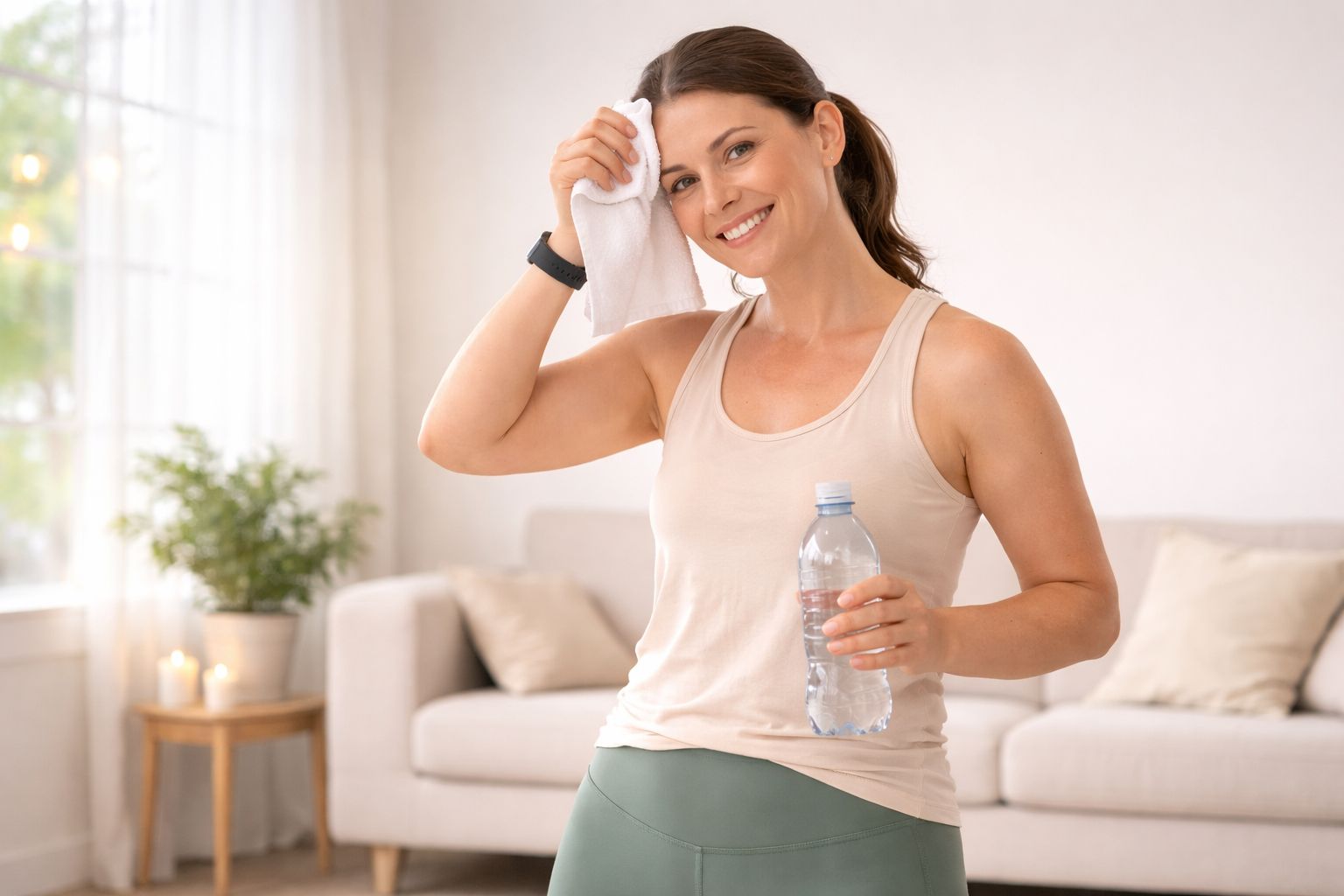
Smiling beginner sitting relaxed after completing a home workout, showing post-exercise confidence and motivation.
  • Set tiny, specific goals — e.g., “do 15 minutes of exercise 3 times this week.”
  • Schedule workouts like appointments — consistency beats intensity early on.
  • Track progress with a simple calendar or app. Celebrate small wins.
  • Find social support — a friend, family member, or online group can help with accountability.
  • Focus on habit formation — aim for 66 days to make things routine, but be patient with yourself.

#How Many Calories Do You Burn in Home Workouts? 2026

Conclusion & Next Steps

You don’t need fancy equipment or a gym membership to start improving your fitness. This home workout for beginners guide gives you 12 simple, effective exercises, safety tips, and sample weekly plans to begin today. Start small, focus on form, and build consistency. Over weeks and months, you’ll gain strength, stamina, mobility, and confidence.